
- Which small-scale edible oil extraction and refining plant supplier fits your startup?
- Which corn germ oil extraction method is best for your plant?
- What is a corn germ oil processing line and how does it work?
- Which supplier can provide a turnkey peanut oil processing plant in Africa?
- Sunflower oil processing plant: capacity, process, equipment and project planning guide
- Mobile/WhatsApp:
+86 13526627860
- Phone:
+86 13526627860
- Email:
sales@doingoilmachine.com
- Glory Oiltech secures 3 TPH palm kernel oil processing plant order in Nigeria
- Glory Oiltech secures 30 TPD soybean oil processing plant order in Nigeria
- Glory Oiltech (a subsidiary of Doing Holdings) Chairman Zheng Yongye reappointed Vice Chairman of NCCEA
- PALMEX Medan 2026: Meet Glory Oiltech and explore 5 TPH palm oil extraction machine solutions
- Want to process peanuts into oil? Here's how one Nigerian customer did it — 3TPD peanut oil expeller
Blog
How to process CPO into edible cooking oil: complete crude palm oil refining process
 Palm oil refining machine
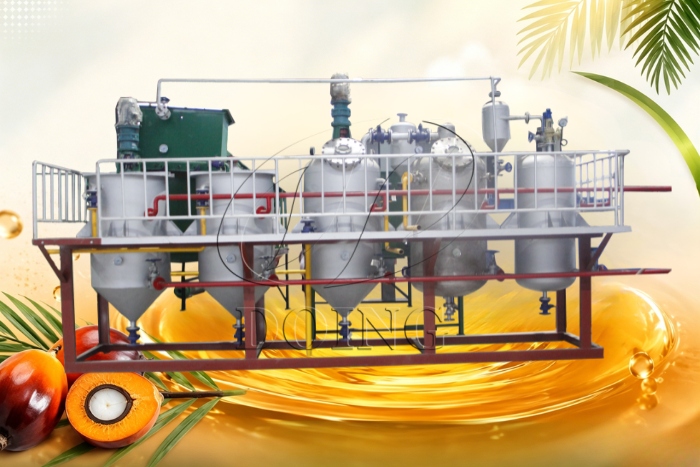
Crude Palm Oil (CPO) is one of the most cost-effective and versatile raw materials for the global edible oil industry. However, raw CPO contains impurities, free fatty acids (FFA), phospholipids, pigments, and peculiar odors that make it unfit for direct culinary use. To turn raw CPO into pure, safe, RBD (Refined, Bleached, Deodorized) palm oil with stable quality and excellent taste, professional oil refining is essential.
Understanding each step of the CPO refining process is the key to making the right equipment choices. Below we break down the complete processing workflow — so you can see exactly what happens at each stage and how it affects your final oil quality.
1. Degumming
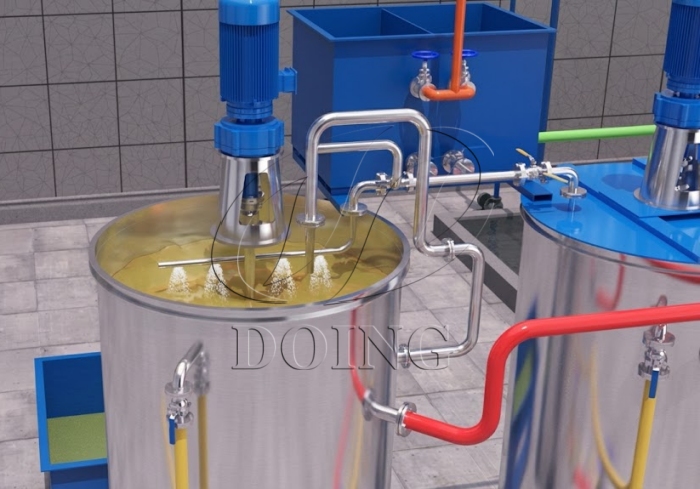
Degumming is the first basic step in the crude palm oil refining process. Raw CPO contains colloidal impurities such as phospholipids (hydratable and non-hydratable), gums, and proteins. If not removed, these impurities will cause oil turbidity, sediment precipitation, and rapid oxidation during storage.
In practice, there are two types of gums to deal with:
Hydratable phospholipids — removed by mixing hot water into the oil, then allowing them to settle or be centrifuged out.
Non-hydratable phospholipids — require a pre-treatment with phosphoric acid to convert them into a water-removable form first.
For smaller operations, a batch tank with settling time is a practical and cost-effective choice. For higher throughput, centrifugal separators (disc centrifuges) offer continuous, faster separation with less oil loss.
 Palm oil refining machine
2. Deacidification
All natural vegetable crude oils contain free fatty acids, and CPO is no exception. Excess FFA causes oil rancidity, sour taste, and significantly shortened shelf life. Whether sold locally or exported, your cooking oil must have FFA reduced to food-grade levels to ensure product quality.
The right approach depends on your production scale and the FFA level of your crude oil:
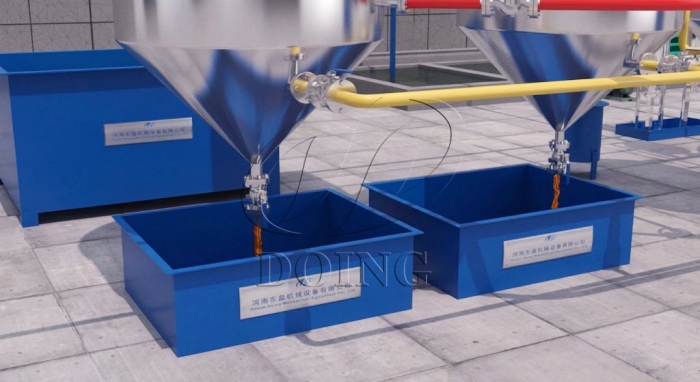
Chemical deacidification (alkali neutralization) Suitable for small to medium-scale lines. Alkali is added to react with the FFA, forming soapstock that is then separated from the oil. It is straightforward to operate and works well when processing multiple oil types in rotation. The trade-off is some neutral oil loss carried away with the soapstock.
Physical deacidification (steam distillation) Suitable for larger continuous lines. Instead of using alkali, the oil is heated under high vacuum and live steam strips the FFA out directly. This method achieves higher oil yield because there is no saponification loss, and the recovered fatty acids are pure enough to sell as a by-product.
If you are processing high-FFA CPO at scale, physical deacidification often makes better economic sense.
 Palm oil refining machine
3. Decolorization (Bleaching)
Unrefined CPO has a deep reddish-brown color from natural carotenoids and other pigments. While this color is natural, it does not meet consumer expectations for cooking oil. Decolorization (also called bleaching) is the step that transforms dark crude oil into the clear, light-colored oil that the market recognizes.
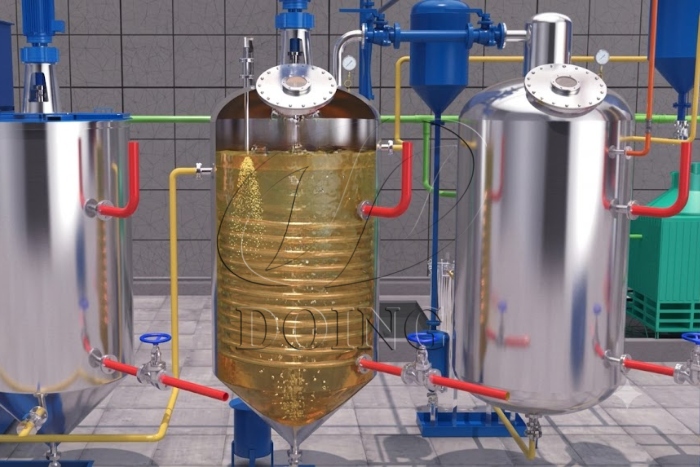
The basic method is adsorption: bleaching earth (activated clay) is mixed into the oil under vacuum to absorb pigments, along with trace impurities like residual soap, phospholipids, and metal ions (iron, copper) that could cause oxidation later. Sometimes a small amount of activated carbon is added for extra color removal.
Key considerations for getting this step right:
Vacuum operation is crucial — it prevents the oil from oxidizing at the elevated bleaching temperature
Dosage matters — too little bleaching earth and the color won’t meet standard; too much increases operating cost and oil retained in spent clay
Filtration — once bleaching is complete, the spent clay must be fully removed. Leaf filters are commonly used for this solid-liquid separation
After bleaching, the oil becomes transparent with a consistent light color — the appearance that signals to buyers this is quality refined oil meeting market standards.
 Palm oil refining machine
4. Deodorization
Even after degumming, deacidification, and decolorization, crude palm oil still carries a distinctive smell — aldehydes, ketones, and other volatile compounds that make it unsuitable for cooking. If your product targets household kitchens or food processing, this final deodorization stage is what gives your cooking oil true market competitiveness.
The principle is the same regardless of scale: heat the oil to around 240-260°C under high vacuum (absolute pressure below 3 mbar), then inject live steam. The steam carries away the volatile odor compounds, while the vacuum prevents the oil from degrading at these high temperatures.
However, the equipment used differs depending on your refining setup:
Batch type refining: Deodorization is carried out in a deodorization tank — a single food-grade stainless steel vessel. The tank design prevents metal ion contamination and is simple to operate and maintain.
Semi-continuous and full-continuous refining: Deodorization is carried out in a multi-tray deodorization tower, where the oil flows gradually from tray to tray under high vacuum conditions while being contacted by stripping steam to remove odor compounds, free fatty acids, and other volatile impurities. This design maximizes steam-oil contact for more efficient volatile removal, and is better suited for steady, high-volume production.
An important bonus regardless of equipment type: the volatiles removed in this process — mainly palm fatty acid distillate (PFAD) — can be condensed and collected as a high-value by-product for the oleochemical industry. So this step not only eliminates the unpleasant odor but also creates an additional revenue stream.
The result is a mild, neutral-tasting cooking oil that is ready for bottling, branding, and delivery to your customers.
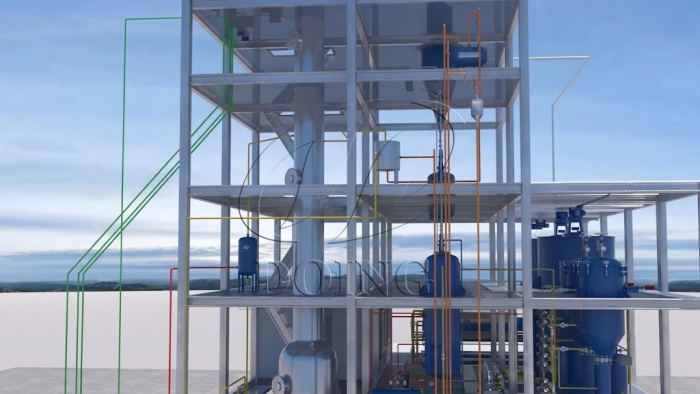 Palm oil refining machine
3 Types of CPO Refining Plants from Henan Glory
Depending on your production scale and budget, Henan Glory offers three configurations:
| Type | Capacity | Best For |
| Batch Type | 1-20 t/d | Small-scale production, multiple oil types, low investment |
| Semi-Continuous Type | 5-30 t/d | batch degumming/bleaching + continuous deodorization |
| Full-Continuous Type | 30-1200 t/d | Large-scale, 24/7 automated production, highest efficiency |
We Help You Solve Real Challenges in CPO Refining
Starting a palm oil refining business comes with real questions: What capacity fits my market? How do I ensure consistent oil quality? Will the equipment handle my local conditions? At Henan Glory Company, we work alongside you to find the right technical path.
Right refining route for your oil. Not every CPO needs the same process. We assess your raw material and production goals first, then recommend the refining line that actually fits — whether chemical or physical, batch or continuous.
Adapted to your local conditions. We have delivered projects across Africa, Southeast Asia, and South America, so we take tropical climate, voltage stability, and local skill levels into account from the start.
Support from start to operation. From process design and manufacturing to on-site installation, commissioning, and worker training — plus a one-year warranty and responsive after-sales support.
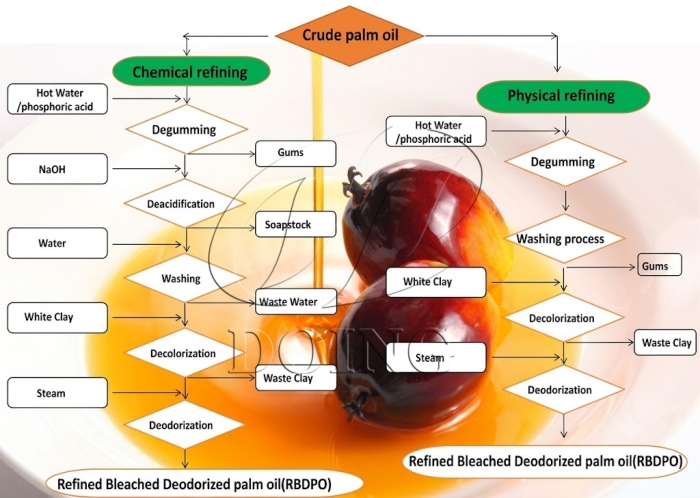 Palm oil refining process
FAQ — Palm Oil Refining Process
Q: What is the difference between chemical and physical refining?
A: Chemical refining uses alkali to neutralize FFA; physical refining uses steam distillation to strip FFA under high vacuum. Physical refining achieves higher oil yield and valuable by-products, making it ideal for large-scale CPO with high FFA content.
Q: How much does a palm oil refinery plant cost?
A: The cost varies significantly by capacity and configuration. A 1–20 t/d batch plant has a much lower investment than a 30–1200 t/d full-continuous line. Contact us with your capacity and raw material details for a tailored quote.
Q: How long does the refining process take per batch?
A: For batch refining, a typical cycle (degumming through deodorization) takes 4–6 hours depending on oil condition and equipment size. Continuous lines operate 24/7 with steady throughput.
Get a Customized CPO Refining Solution
Ready to process CPO into edible cooking oil? Tell us your needs and our engineers will design the right solution for you.
Leave a message with:
- Your raw material (CPO / palm kernel oil / other)
- Required capacity (tons per day)
- Your preferred refining type (batch / semi-continuous / full-continuous)
Our sales manager will contact you within 48 hours.
 PREV:Soybean puffing and pressing process: Complete equipment & flow guide
 NEXT:What are the advantages of a double screw palm oil press machine?
Leave a message
If you wanna to get more details about How to process CPO into edible cooking oil: complete crude palm oil refining process, you can send E-mail to sales@doingoilmachine.com. Or you can consult our professional engineers and specialized sales team by leaving a message in below form. We will contact you ASAP. You also can visit our factory in Henan, China.
- QWhat is your raw material?
- QHow many tons do you want to process per day?
- QWhat machine do you want? or other requirement?

