
- Is it profitable to add a rice bran oil extraction line to an existing rice mill in India?
- Olive pomace solvent extraction plant: process & equipment
- Small-scale coconut oil refining: Is batch refining unit feasible for 3 TPD project
- Cold pressing vs hot pressing oil expeller: Yield & quality differences explained
- 5 TPD cottonseed oil pressing line: Complete setup from cleaning to filtering for startups
- Mobile/WhatsApp:
+86 13526627860
- Phone:
+86 13526627860
- Email:
market@gloryoiltech.com
- Glory Oiltech Wins Order for Idesia Polycarpa Fruit Oil Pressing and Refining Line for a North Korea Project
- Glory Oiltech wins 50TPD full-continuous palm oil refining plant order from Mexican client
- The 19th Nigeria (Lagos) China Commodities Expo 2026: Glory Oiltech Presents Complete Palm Oil Processing Solutions at Booth 1B09
- Glory Oiltech to showcase 1 TPH integrated palm oil processing line at PALMEX Malaysia 2026
- Glory Oiltech wins order for 1TPH double screw palm oil press machines for Congo palm project
Blog
Is it profitable to add a rice bran oil extraction line to an existing rice mill in India?
Yes — adding a rice bran oil extraction line to an existing rice mill in India can be a sound investment, but the profit does not come from the equipment alone. It comes from three things working together: how quickly you stabilise the bran after milling, whether the extraction route is right for this awkward feedstock, and whether you find buyers for the oil and the by-products. Get the first one wrong and the rest of the economics quietly fall apart.
This article walks through the rice bran oil profitability from a mill owner's point of view: what makes rice bran processing different from other oilseeds, what a working extraction line actually requires, how rice bran oil refining and wax recovery add value, and the conditions under which the investment tends to pay for itself.
 Sources of rice bran
Why Rice Bran Processing Starts Differently at Your Own Mill
Oil Content and Yield per 100 kg of Paddy
Rice bran is what is left after milling — the outer layers, the germ and a little broken rice. For every 100 kg of brown rice milled, you get roughly 5–8 kg of bran, and that bran typically carries 18–20% oil depending on the variety and how finely the rice is milled. The number varies: glutinous rice bran can run 20–22%, while japonica bran is closer to 15–18%.
The figures in this section are drawn from the project experience and internal technical data of Glory Oiltech (Henan Glory).
| Item | Typical figure |
|---|---|
| Oil content of rice bran | 18–20% (varies by variety) |
| Bran per 100 kg brown rice | 5–8 kg |
| Residual oil after solvent extraction | below 1% |
| Window before rancidity begins | about 6 hours after milling |
On paper, 18–20% oil is modest next to soybean or sunflower seed. What changes the picture is that at a rice mill this feedstock is already on site — you are not buying it in, and you are not paying to bring it in from somewhere else. The by-product stream becomes a raw material at almost no acquisition cost.
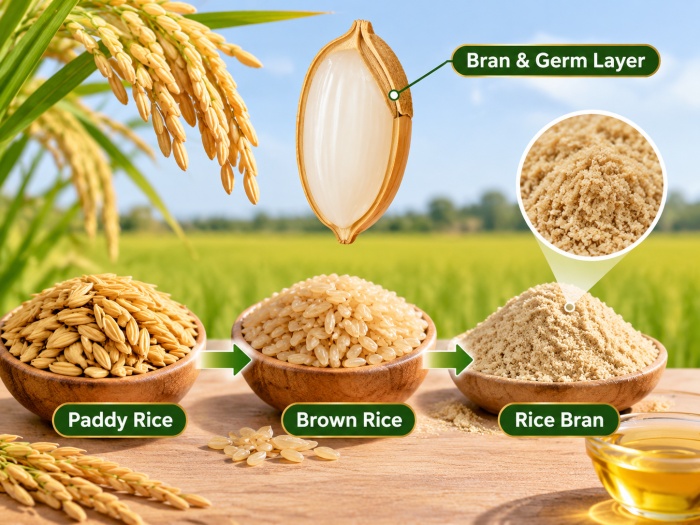 Structure of rice
The Six-Hour Window: Lipase, FFA and Why Timing Decides Profit
Rice bran contains active lipase. Left sitting after milling, it starts to go rancid in roughly six hours, and the free fatty acid (FFA) content climbs. High-FFA crude oil is harder and more expensive to refine, which means a larger refining loss and a thinner margin — decided at the milling line, not later in the workshop.
Under proper operation, fresh bran is stabilised straight away. That means separating out the broken rice and impurities, conditioning and cooking the bran, then expanding it to deactivate the enzyme and improve solvent penetration before extraction. Once expanded, an added deactivator can extend storage to around 10–15 days, but the better practice is still to extract as soon as the mill can feed it.
This is where an integrated setup earns its keep. Bran that would otherwise be sold cheaply as feed, or left to deteriorate in a pile, can be turned into oil within hours of being produced. For a rice mill in India already running around the clock, the six-hour window is less a problem than an advantage over competitors who have to collect bran from scattered mills — and it is the main reason a rice bran oil extraction line makes sense on-site rather than at a distant plant.
Why Solvent Extraction Is the Standard for a Rice Bran Oil Extraction Line
Why Rice Bran Favours Extraction over Pressing
Rice bran is low in oil and dry, which makes it an awkward feedstock for a press. In a project for a Turkish customer, Glory Oiltech supplied a rice bran oil expeller after the customer found that local operators were failing to get usable crude oil from the same material — the oil content was simply too low and the bran too dry compared with soybean, peanut or sunflower seed.
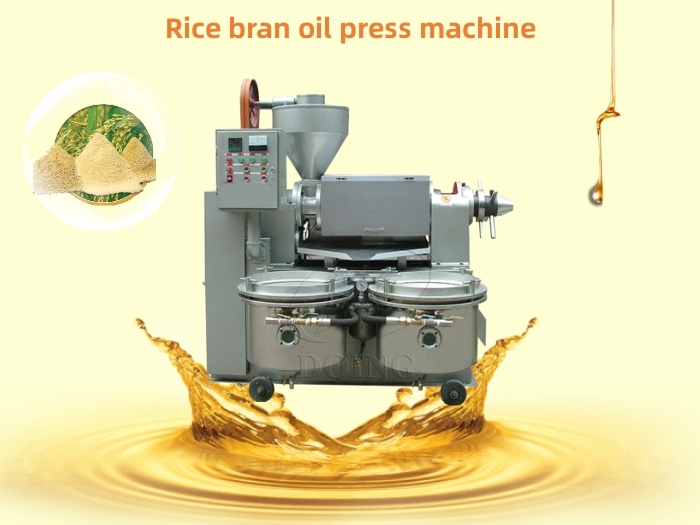 Rice bran oil press machine
The practical answers were to use fresh bran, add a little water and steam at high temperature before pressing to raise the moisture, and run a long four-stage press screw so the material stayed in the pressing chamber long enough.
That case makes the broader point. Pressing rice bran can be done, but it asks for careful handling and still leaves more oil behind. Solvent extraction, by contrast, brings residual oil below 1%. For rice bran specifically, extraction is the route that makes the feedstock worth processing in a rice bran oil extraction line — and the pretreatment ahead of it matters as much as the extractor itself.
The Complete Extraction Line: Pretreatment to Solvent Recovery
A rice bran extraction line is a chain, not a single machine. Bran passes through a Rice Bran-Germ Separation Unit to remove broken rice and impurities, then a conditioning cooker, an expander and a chain dryer before it reaches the extractor. The miscella then goes through evaporation and stripping to recover the solvent and produce crude rice bran oil, while the wet meal is desolventised and dried into feed-grade meal.
Equipment configuration based on Glory Oiltech's rice bran extraction projects:
| Stage | Equipment | Purpose |
|---|---|---|
| Cleaning | Rice bran–germ separation unit | Remove broken rice (sellable) and impurities |
| Conditioning | Vertical stack cooker | Deactivate lipase, adjust moisture and temperature |
| Expansion | Expander / screw extruder | Rupture cells, improve solvent penetration |
| Drying | Chain dryer | Bring material into the extraction range |
| Extraction | Rotary-type extractor (Rotocel) | Recover oil, residual oil below 1% |
| Desolventising | Desolventizer-toaster | Recover solvent, produce feed-grade meal |
| Miscella treatment | Evaporators and stripping column | Separate solvent from crude oil |
Before extraction, rice bran is typically conditioned to around 2.5–3.6% moisture at 120–125°C, and leaves the cooker at roughly 7–9% moisture and about 105°C. The expander works by friction and pressure — around 13–41 MPa and 112.8°C with 10–13% moisture — tearing the cell structure so solvent can reach the oil directly. In practice this can raise extractor throughput by 30–50% against non-expanded meal.
Glory Oiltech designs solvent extraction plants at 20 TPD and above, and this applies to other oilseeds as well — below that scale a solvent project generally does not justify the investment.
What Equipment the Line Actually Needs
Pretreatment: Separation, Conditioning, Expansion, Drying
Pretreatment decides how much oil the extractor can actually reach. Broken rice recovered at the separation stage can be bagged and sold, which is a small but real revenue line.
The vertical stack cooker should be a multi-layer unit rather than a drum cooker: water is added so the protein denatures and the oil separates out, while the lipase is deactivated at the same time. The expander then breaks the cell walls, and the dryer brings the material into the right moisture and temperature range for solvent contact.
Skipping the expander or the dryer to save capital is a false economy. Without expansion, solvent penetrates poorly and residual oil rises; without drying, extraction conditions drift and solvent recovery suffers. This pretreatment sequence is standard in rice bran processing wherever the bran is to be extracted rather than pressed.
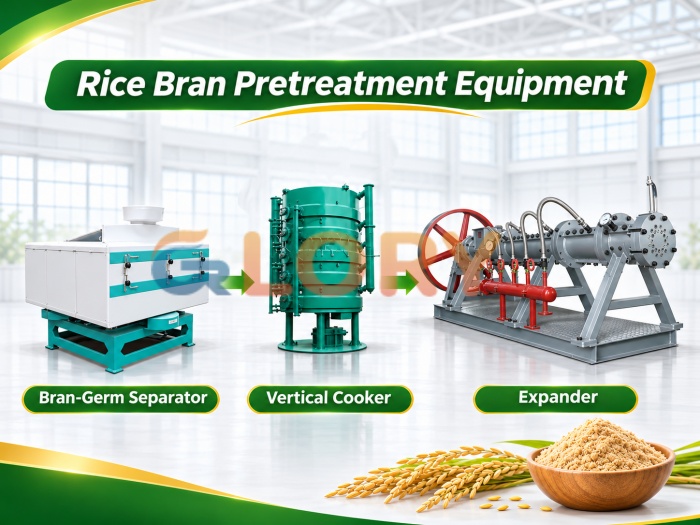 Rice bran pretreatment equipment
Oil Extraction Unit
Extraction itself is a continuous counter-current process: solvent meets the prepared bran, dissolves the oil, and the resulting miscella is filtered to remove meal fines before evaporation and stripping. The extractor type follows capacity — rotary designs for smaller lines, ring or drag-chain extractors for larger ones — and the solvent system needs to be complete, including condensation, water separation and recovery, both for operating cost and for safety.
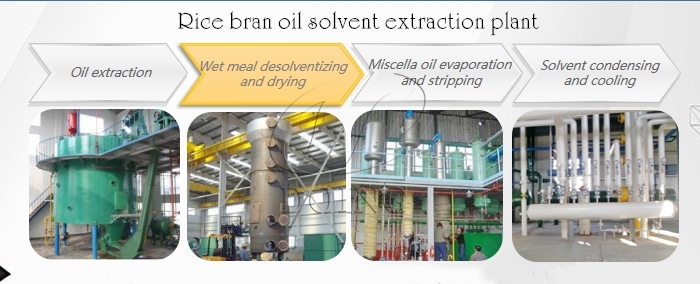 Rice bran oil solvent extraction plant
Rice Bran Oil Refining and Dewaxing — Mandatory, Not Optional
Crude rice bran oil cannot go to market as edible oil without rice bran oil refining. It is high in gums and wax, and it darkens easily when the gums are not properly removed, which is why physical refining built around thorough degumming is the usual route. The sequence runs through degumming, drying, bleaching, deacidification and deodorization, then dewaxing and winterization. Dewaxing is not optional: rice bran wax precipitates at low temperature and leaves the oil cloudy if it stays in.
Refining also creates its own revenue streams. Rice bran wax and fatty acids are recovered as by-products and sold into food, cosmetic and chemical applications.
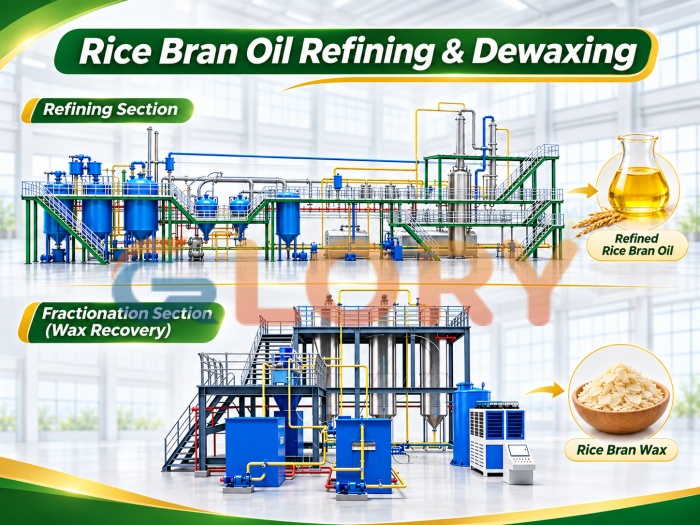 Rice bran oil refining and dewaxing equipment
Where the Profit Really Comes From
Crude Oil Versus Refined Oil Margin
Selling crude oil is simpler, but the margin per tonne is far thinner than selling refined, dewaxed oil into the food market. According to Expert Market Research, rice bran oil in India traded around USD 1,300 per tonne in the second quarter of 2026, with a 2026 range of roughly USD 1,261–1,391 per tonne. Prices move with the wider edible-oil market, so treat these as indicative rather than fixed.
For a mill, the more important point is control. Refining on site captures the margin that would otherwise go to a third-party refinery, and it gives you a product with a longer shelf life and a cleaner quality story to tell.
By-product Revenue: Broken Rice, Deoiled Rice Bran, Wax and Fatty Acids
Three by-products carry part of the economics of rice bran processing:
Broken rice separated at the front end is saleable as is.
Deoiled rice bran (DORB) is a feed ingredient. Industry supplier data from Brinda Foods (October 2026) puts feed-grade deoiled rice bran at roughly ₹19–20/kg, with better-graded, lower-residual-oil material toward the upper end of that range.
Rice bran wax and fatty acids recovered during rice bran oil refining are raw materials for the food, cosmetic and chemical industries. Rice bran wax, in particular, has a ready market in cosmetics and food formulations.
India imports roughly two-thirds of its edible oil, according to Solvent Extractors' Association data reported by industry media. That keeps domestic oil prices supported and gives locally produced rice bran oil a ready market — which is good news for a mill sitting on an unused by-product.
Cost Side: Steam, Power and Refining Loss
The main running costs are steam for cooking and desolventising, power for the extractor and solvent recovery, and the loss incurred during refining. An existing rice mill is well placed here.
If the mill already has a boiler, steam can be shared with the oil line, so most of the extra capital goes into the extraction and refining equipment rather than a new utility plant. Refining loss, meanwhile, is driven by how fresh the bran was when it was processed — which brings the economics back to the first section of this article.
Conditions That Decide Whether It Pays Off
Minimum Viable Scale
A solvent extraction line needs enough bran to run continuously, which is why 20 TPD is the practical design threshold. If your mill produces less than that, the bran is better sold as feed or to a nearby oil plant than tied up in an extraction line that spends most of its time idle.
Fresh Bran Handling and Storage
The line only works if the bran moves quickly. A mill that can put fresh bran into pretreatment within hours of milling has a genuine cost advantage; a mill that stores bran in bags for weeks will fight high FFA and poor refining yields no matter how good the equipment is.
Utility Integration with the Existing Mill
Shared steam, existing workshops and an established maintenance team all lower the entry cost. Check boiler capacity and layout before committing to a new line — utility shortfalls are one of the more common reasons an otherwise sound project underperforms.
Local Market Access for RBD Oil and Meal
Rice bran oil profitability also depends on what you can sell nearby. Refined oil needs a food-grade channel, and deoiled rice bran needs a feed buyer within a reasonable freight radius, given its low value per kilogram. Rice mills in India close to feed-producing regions or urban food markets have a shorter route to margin than those in remote areas.
FAQ
How much oil can I get from one tonne of rice bran?
Rice bran typically contains 18–20% oil, but how much you actually recover in rice bran processing depends on the route. Pressing recovers roughly 12% with 6–7% left in the cake, while the solvent stage of a rice bran oil extraction line can bring residual oil below 1%. Pretreatment — especially cooking and expansion — has a large effect on the final figure.
Why is solvent extraction preferred for rice bran over pressing?
Because rice bran is low in oil, dry, and quick to deteriorate, a press alone leaves too much oil behind and demands very careful feedstock handling. Solvent extraction recovers far more of the available oil and produces a meal with low residual oil, which is why it is the standard route wherever the scale justifies it.
Why does rice bran oil have to be dewaxed?
Rice bran oil contains a high level of wax. If the rice bran wax is not removed, the oil turns cloudy at low temperature, which customers read as poor quality. Dewaxing and winterisation are therefore a mandatory part of rice bran oil refining, not an optional finishing step.
Can we share the boiler and utilities with the existing rice mill?
Usually yes, and it is one of the main reasons an integrated project is cheaper than a standalone oil plant. The mill's boiler can supply steam for cooking, drying and desolventising, provided capacity has been checked. Water, power and workshop space should be reviewed at the same time.
How quickly must fresh bran be processed after milling?
Ideally within hours. Rice bran begins to go rancid in about six hours as lipase drives up the free fatty acid content. Stabilising it immediately through cooking and expansion, and extracting as soon as the mill can feed it, protects both the oil quality and the refining margin.
Get a Rice Bran Oil Extraction Plan Built Around Your Mill
If you are running a rice mill in India and weighing up a rice bran oil extraction line, the next step is not a machine catalogue — it is a line configured around your own numbers. How much bran do you generate each day? How quickly can it reach pretreatment? Does your boiler have spare capacity? Who would buy the refined oil and the deoiled rice bran locally? These are the questions that decide whether the project works, and they are the ones we start with.
Share your mill's capacity, bran availability and utility conditions with Glory Oiltech, and our engineers will assess the rice bran oil profitability for your specific case and propose an extraction line that fits your scale — from pretreatment through refining and dewaxing.


Leave a message
If you wanna to get more details about Is it profitable to add a rice bran oil extraction line to an existing rice mill in India?, you can send E-mail to market@gloryoiltech.com. Or you can consult our professional engineers and specialized sales team by leaving a message in below form. We will contact you ASAP. You also can visit our factory in Henan, China.
- QWhat is your raw material?
- QHow many tons do you want to process per day?
- QWhat machine do you want? or other requirement?

