
- What equipment do you need for a 50 tpd rice bran oil extraction and refining plant?
- How to start a small groundnut oil business in Nigeria: Complete machine list & process guide
- Batch vs. continuous oil refining: What's the difference for a small edible oil factory?
- Rapeseed oil pressing vs extraction: Which method is right for your business?
- How much power, space and time does a 1 TPD small edible oil refinery really need?
- Mobile/WhatsApp:
+86 13526627860
- Phone:
+86 13526627860
- Email:
sales@doingoilmachine.com
- Glory Oiltech wins order for 1TPH double screw palm oil press machines for Congo palm project
- Glory Oiltech secures 3 TPH palm kernel oil processing plant order in Nigeria
- Glory Oiltech secures 30 TPD soybean oil processing plant order in Nigeria
- Glory Oiltech (a subsidiary of Doing Holdings) Chairman Zheng Yongye reappointed Vice Chairman of NCCEA
- PALMEX Medan 2026: Meet Glory Oiltech and explore 5 TPH palm oil extraction machine solutions
Blog
What equipment do you need for a 50 tpd rice bran oil extraction and refining plant?
Setting up a 50 TPD rice bran oil plant? You need a complete production line covering four stages: pretreatment, solvent extraction, refining, and dewaxing. Each stage requires specific equipment to ensure stable operation, high oil recovery, and food-grade final product quality.
Below is the full equipment list organized by production stage:
| Stage | Key Equipment | Function |
|---|---|---|
| Pretreatment | Bran Separator Screen, Vertical Multi-Layer Cooker, Expander | Separate broken rice from bran, deactivate enzymes, prepare material for extraction |
| Solvent Extraction | Rotocel Extractor, DTDC, Evaporators & Stripper, Solvent Recovery System | Extract crude oil from stabilized bran using solvent |
| Refining | Degumming & Deacidification Tank, Bleaching Tank, Continuous Deodorizing Tower | Remove gums, free fatty acids, pigments, and odors |
| Dewaxing | Crystallization Tank, Plate-Frame Filter, Refrigeration Unit | Remove wax for clear, market-ready oil |
Why Solvent Extraction is the Right Choice for 50 TPD Rice Bran Oil Plant
Rice bran is a challenging raw material. Its oil content is relatively low — typically 18–20% — and it contains active enzymes that cause rapid acidification if not stabilized immediately after milling.
Based on our experience at Glory Oiltech (Henan Glory), for a 50 TPD scale, solvent extraction is the proven and economical choice. Here is why:
Higher oil recovery: Solvent extraction achieves a comprehensive recovery rate of 90–99%, with residual oil in meal below 1%. By comparison, mechanical pressing leaves 6–7% oil in the cake — a significant loss at this scale.
Better economics above 30 TPD: Industry data shows that for capacities exceeding 30 TPD, solvent extraction delivers the best return on investment due to lower per-ton operating costs and higher oil yield.
Meal quality: The extracted meal retains protein quality and can be sold directly as animal feed after desolventizing.
While screw pressing works for small-scale or specialty operations, solvent extraction is the standard for commercial rice bran oil production at 50 TPD and above.
Core Equipment for Each Production Stage
Pretreatment Equipment
Pretreatment prepares raw rice bran for efficient extraction. This stage is critical because rice bran deteriorates quickly after milling.
Bran Separator Screen — The first step in the pretreatment line. Rice bran obtained from milling inevitably contains broken rice, germ, and other impurities. The bran separator screen uses sieving and air classification to separate broken rice from pure bran (capacity approximately 2 TPH). The separated broken rice can be packaged and sold as a by-product, improving overall economics. For smaller-scale operations, a simple sieve may suffice.
Vertical Multi-Layer Cooker — The most important pretreatment step for rice bran. Rice bran contains abundant lipase enzymes that cause rapid acidification; without proper deactivation, the crude oil quality deteriorates before refining even begins. The vertical multi-layer cooker steams and conditions the bran at around 120°C to deactivate these enzymes. A vertical design is essential — horizontal drum cookers cannot provide adequate moisture conditioning.
Expander / Screw Extruder — Extrudes the cooked bran into porous pellets, increasing bulk density from approximately 380 kg/m³ to 500 kg/m³ and improving extractor throughput by about 30%. Operating temperature reaches around 140°C through friction heating, so minimal external heat is needed. The extrusion process breaks down cell structures, fully exposing the oils for extraction and significantly reducing residual oil in the meal.
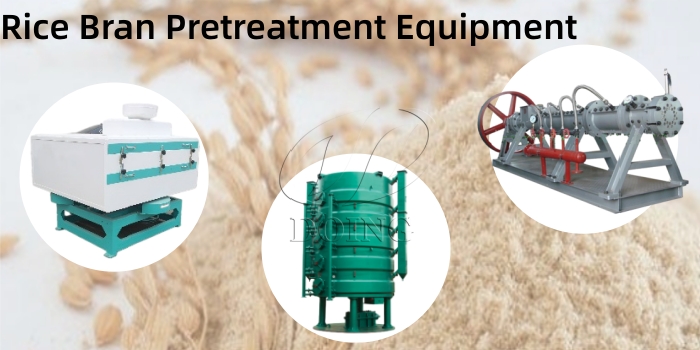 Rice bran pretreatment equipment
Solvent Extraction Equipment
This is the heart of the plant. The extraction section converts stabilized rice bran into crude oil and desolventized meal.
Rotocel Solvent Extractor — Uses n-hexane solvent in a counter-current flow to extract oil from expanded bran pellets. The rotor contains 12–24 independent extraction cells that slowly rotate, passing through spray zones where fresh solvent and increasingly concentrated miscella are applied. Comprehensive oil recovery reaches 90–99%, with residual oil in meal below 1%.
DTDC System — Removes and recovers solvent from wet meal in a single continuous unit. The wet meal undergoes desolventizing, toasting, drying, and cooling stages. Desolventized meal contains less than 500 PPM residual solvent and can be sold directly as animal feed.
Miscella Processing — Evaporators & Stripper — A multi-stage evaporation and stripping system separates solvent from the mixed oil (miscella). The first evaporator concentrates the miscella, the second evaporator further reduces solvent content, and the stripper uses direct steam under vacuum to remove the final traces of solvent.
Solvent Recovery System — Condenses solvent vapor from all exhaust streams back into liquid for reuse. A condenser cools the vapor, a water separator removes entrained solvent, and the recovered hexane is returned to the extraction loop. This closed-loop design minimizes operating costs and ensures safe, environmentally compliant operation.
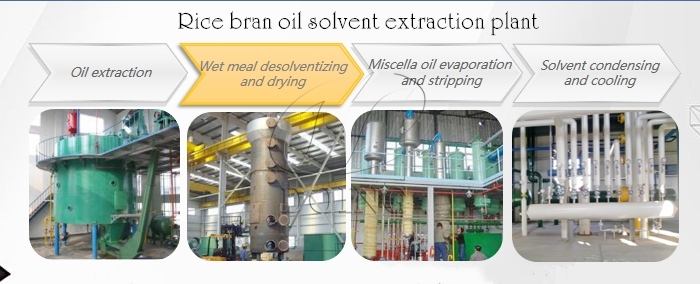 Rice bran oil solvent extraction plant
Refining Equipment
The refining section converts crude rice bran oil into edible-grade oil. Glory Oiltech offers batch, semi-continuous, and fully continuous refining configurations, and the selection depends on your automation requirement, product specification, and budget. For a 50 TPD plant, a semi-continuous configuration is typically most economical — in this setup, degumming, deacidification, and bleaching are batch-type operations, while deodorization runs continuously in a tower.
Degumming & Deacidification Tank — Crude rice bran oil is treated in batch tanks for degumming, neutralization, washing, and drying. Typical operating temperature is around 60–85°C. Batch operation gives good flexibility when crude oil quality varies. Proper degumming is essential — if gums are not removed, they will cause fouling and scorching in downstream heating equipment during deacidification and deodorization.
Bleaching Tank — The oil is heated under vacuum, mixed with activated bleaching earth, and then filtered to remove pigments, residual gums, and trace impurities. A plate-and-frame filter or leaf filter is used to separate spent clay.
Continuous Deodorizing Tower — Bleached oil is continuously fed into the deodorizing tower, where high temperature, deep vacuum, and direct steam stripping remove odor substances and residual free fatty acids. Deodorization typically runs at 230–260°C under deep vacuum, often ≤200–300 Pa. The continuous tower provides more stable oil quality and better heat recovery than a batch deodorizing pot.
Vacuum System — Provides the required vacuum for bleaching and deodorization. A stable vacuum level is important for efficient deodorization and for preventing oil oxidation at high temperature.
Thermal Oil Furnace / Steam Generator — The thermal oil furnace supplies indirect heat for degumming, bleaching, and deodorization, while the steam generator produces direct steam for deodorization stripping.
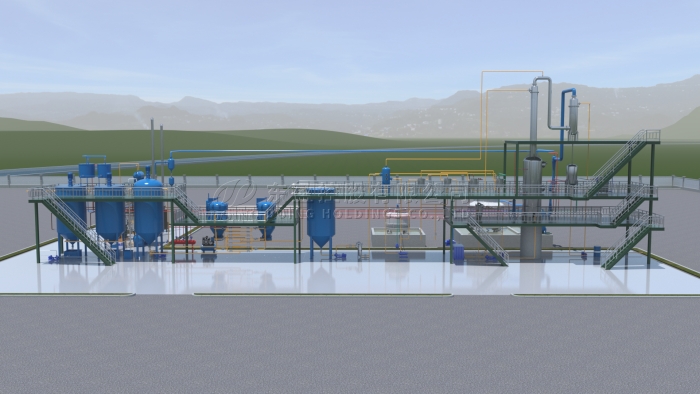 Semi-continuous rice bran oil refinery plant
Dewaxing Equipment
Rice bran oil naturally contains wax that causes cloudiness and sediment below 5°C. Dewaxing is essential for market-ready, clear cooking oil.
Crystallization Tank — Cools the oil gradually using circulating refrigerant through coil pipes inside the tank. Equipped with variable-speed mechanical agitation to ensure uniform crystal formation.
Dewaxing Plate-Frame Filter — Press-filters the crystallized oil to separate wax crystals, producing clear dewaxed oil.
Cooling Unit — Provides the cooling source for crystallization.
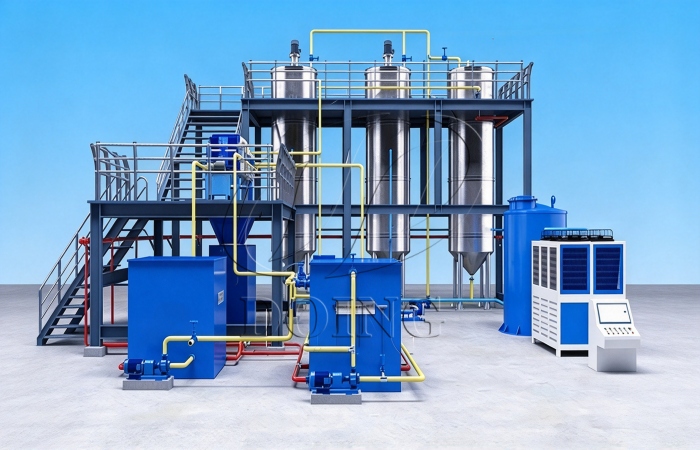 Rice bran oil dewaxing equipment
Why Choose Glory Oiltech
Proven project experience: Successfully delivered a 100 TPD rice bran oil expansion-extraction project in Egypt, demonstrating end-to-end capability in rice bran oil plant design, manufacturing, and commissioning.
ISO certified manufacturing: Our production facility covers 40,000 m² with a monthly shipment capacity of 4–5 complete production lines, ensuring reliable delivery schedules even for urgent projects.
Proprietary technology: Holder of 19 utility model patents in oil processing equipment design, covering extraction, refining, and pretreatment innovations.
Global service network: With a branch office and 1,000 m² warehouse in Ogun State, Nigeria, we provide fast local support for African projects. Our engineers stay on-site until the entire line runs normally — not just until equipment is installed.
Turnkey EPC capability: From process consulting and engineering design to equipment manufacturing, installation, commissioning, and after-sales support — we deliver complete, ready-to-operate plants, not just individual machines.
Frequently Asked Questions
How long does it take to install a 50 TPD rice bran oil plant?
Installation time depends on site conditions and labor availability. With a full crew in place, a 50 TPD line typically takes about 2.5 months to install and commission. If local labor is limited, the timeline may extend to 4 months or more. Our engineers stay on-site until the entire line is running normally — not just until equipment is delivered.
What infrastructure and utilities should I prepare before the equipment arrives?
Before equipment delivery, ensure you have: (1) a leveled concrete foundation capable of supporting heavy machinery; (2) three-phase electrical supply matching each machine's power rating; (3) a reliable steam source for pretreatment and refining; (4) adequate water supply for cooling and processing; and (5) a ventilated, well-drained site for the full plant layout. Glory Oiltech's engineering team provides a detailed site preparation checklist during the design phase.
What after-sales support and spare parts strategy should I plan for?
We recommend ordering a spare parts kit together with the main equipment — typically including filter cloths, seals, gaskets, bearings, and wear parts for the extruder and extractor — which covers 12–18 months of normal operation. Additionally, we provide remote troubleshooting via video call and can dispatch engineers for major maintenance visits.
Get Your Customized Rice Bran Oil Processing Plant Solution
Whether you are building a new plant or upgrading an existing line, Glory Oiltech provides fully customized rice bran oil processing solutions from process design through equipment supply and commissioning. Our systems cover capacities from 1 TPD to 2,000 TPD across all major oil types.
Contact us today with your raw material source, target capacity, and budget — our engineers will design a customized solution for you.
 PREV:Nothing
 NEXT:How to start a small groundnut oil business in Nigeria: Complete machine list & process guide
Leave a message
If you wanna to get more details about What equipment do you need for a 50 tpd rice bran oil extraction and refining plant?, you can send E-mail to sales@doingoilmachine.com. Or you can consult our professional engineers and specialized sales team by leaving a message in below form. We will contact you ASAP. You also can visit our factory in Henan, China.
- QWhat is your raw material?
- QHow many tons do you want to process per day?
- QWhat machine do you want? or other requirement?

