
- 100TPD soybean oil processing plant: expanding pressing vs expanding extraction
- What refining equipment for a small rural oil mill? Complete buyer's guide
- Oilseed pretreatment guide: Choosing the right process and equipment for each seed type
- Why is oil loss too high during edible oil refining? Causes & solutions
- What equipment do you need for a 50 tpd rice bran oil extraction and refining plant?
- Mobile/WhatsApp:
+86 13526627860
- Phone:
+86 13526627860
- Email:
sales@doingoilmachine.com
- Glory Oiltech wins order for 1TPH double screw palm oil press machines for Congo palm project
- Glory Oiltech secures 3 TPH palm kernel oil processing plant order in Nigeria
- Glory Oiltech secures 30 TPD soybean oil processing plant order in Nigeria
- Glory Oiltech (a subsidiary of Doing Holdings) Chairman Zheng Yongye reappointed Vice Chairman of NCCEA
- PALMEX Medan 2026: Meet Glory Oiltech and explore 5 TPH palm oil extraction machine solutions
Why is oil loss too high during edible oil refining? Causes & solutions
Oil loss is too high when neutral oil leaves the line with gum, soapstock, spent clay or deodorization distillate instead of with your finished oil. The usual triggers are emulsion formed by wrong temperature or wrong water and acid dosage in degumming, over-saponification and poor centrifugal separation in neutralization, overdosed or caked bleaching earth in bleaching, and unstable vacuum or excessive stripping steam in deodorization. Crude oil quality and outdated equipment sit behind all of them.
Based on project experience from edible oil refining plant projects, Glory Oiltech (Henan Glory) outlines the main causes of oil loss at each refining stage, along with corresponding solutions.
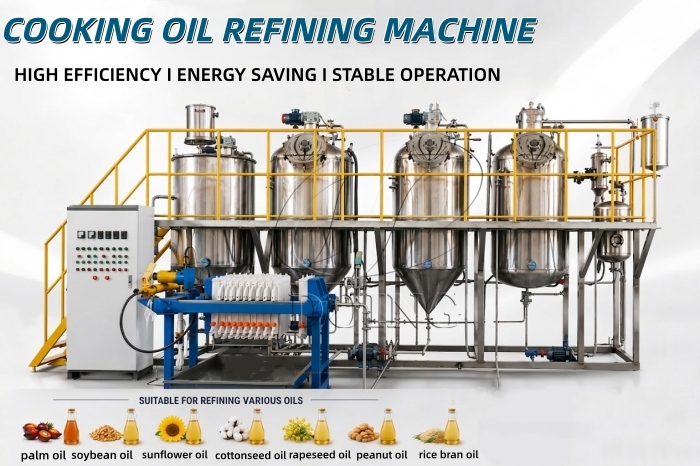 Edible oil refining plant from Glory Oiltech
Where the Oil Goes: Stage-by-Stage Diagnosis
Degumming: Emulsion Traps Valuable Oil
If temperature drifts outside the usual 70 to 90°C range, or water and acid dosage is wrong, a tight emulsion forms instead of clean gum separation, and neutral oil leaves with the sludge. Non-hydratable phospholipids are difficult to remove with plain water degumming, and they later cause trouble in bleaching and deodorizing. In cold seasons, a rushed settling period also leaves oil trapped in the oil foot.
Flow to check: temperature control → water and acid dosage → mixing intensity → actual settling time → gum discharge
Neutralization: Soapstock Steals Neutral Oil
Excess caustic soda causes over-saponification and converts part of your neutral oil into soap. Poor mixing makes it worse, because some zones are under-treated while others are over-treated. Separation quality matters just as much: when centrifugal separation is weak, soapstock carries a high oil content. In practice, soapstock from batch refining can carry around 40% oil, while continuous refining is usually closer to 30%, a large difference when calculated per ton across a year.
Flow to check: crude FFA test → NaOH calculation → mixing uniformity → centrifugal separation → soapstock oil content
Bleaching: Activated Clay Holds Onto Oil
Bleaching earth and activated clay work by adsorption, and they adsorb oil along with colorants. Overdosing is one of the easiest mistakes to fix, since many mills add more clay hoping for faster decolorization and simply pay for it in lost oil. Clay caking creates a second problem: decolorization becomes uneven, filtration gets worse and more residual oil stays in the spent clay.
Flow to check: clay dose per ton → dispersion quality → temperature and contact time → filter condition → spent clay residual oil
Deodorization: Vacuum Problems Carry Oil Away
When vacuum is insufficient or fluctuating, or when stripping steam is too heavy, neutral oil droplets can be carried into the distillate. This is also why some mills see off-flavors returning after deodorization, because the process was never truly complete. Running above roughly 260°C can damage the oil, and for batch deodorizing kettles carbon steel is not a safe choice at high temperatures because manganese and carbon transfer can affect oil safety, so food-grade 304 stainless steel is the practical option.
Flow to check: vacuum pump → sealing condition → steam flow rate → temperature stability → distillate carryover
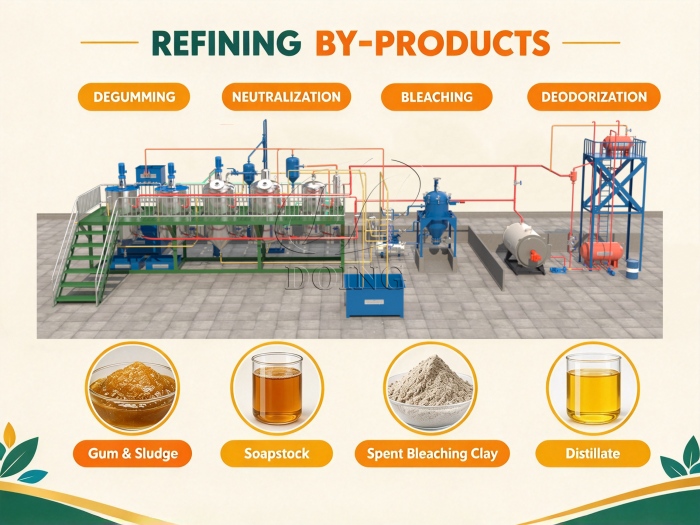 Byproducts of each stage of edible oil refining
Root Causes Beyond the Process
1. Crude oil quality. High free fatty acids, high non-hydratable phospholipids and degraded raw material all increase by-product volume and push refining loss up. For high-acid crude, alkali refining creates heavy soapstock and large amounts of wastewater.
2. Refining route mismatch. A fully continuous line for a small operation makes investment recovery difficult, while a batch-type edible oil refining plant at large scale usually means higher consumption.
3. Outdated or undersized equipment. Gravity sedimentation tanks, weak filters, leaking seals and poor heat exchange add hidden loss over time, and upgrading the bottleneck machine often pays back faster than rebuilding a whole edible oil refining equipment line.
How to Reduce Oil Loss in Edible Oil Refining
1. Upgrade to high-speed centrifugal separation. Replace gravity settling tanks with disc stack centrifuges so less oil leaves with gum and soapstock.
2. Control caustic dosing strictly. Calculate NaOH from actual FFA instead of habit, and verify mixing uniformity before separation.
3. Cut bleaching earth to the minimum effective dose. Improve dispersion to avoid caking, use efficient leaf or plate-and-frame filters, and consider recovering oil from spent clay.
4. Consider physical refining for high-FFA oils. For palm oil and rice bran oil it skips caustic neutralization and reduces soapstock loss and wastewater, but it requires thorough degumming, otherwise residual phospholipids cause color reversion and neutral oil loss during deodorization.
5. Stabilize deodorization vacuum and steam. Keep vacuum steady and avoid heavy stripping that carries neutral oil into the distillate.
6. Add automated dosing and online monitoring. Automated chemical dosing prevents over-addition, and online temperature and vacuum monitoring lets operators correct drift before it becomes loss.
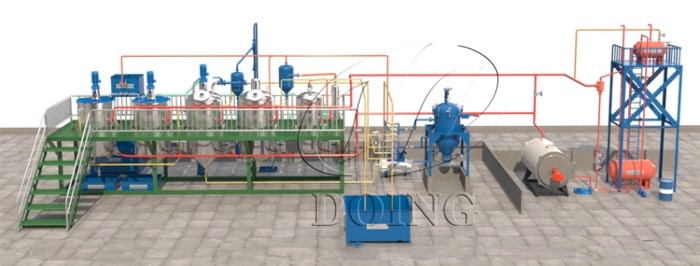 Edible oil refining plant from Glory Oiltech
Quick Reference Checklist
| Refining Stage | Common Loss Cause | Quick Fix | Equipment to Check |
|---|---|---|---|
| Degumming | Emulsion from wrong temperature, water or acid ratio | Hold 70 to 90°C, optimize acid dosage, extend settling in winter | Degumming tank, dosing pumps, agitator |
| Neutralization | Excess caustic soda, poor centrifugal separation | Recalculate NaOH from FFA, upgrade to disc stack centrifuge | NaOH dosing pump, centrifuge for oil separation |
| Bleaching | Overdosed bleaching earth, clay caking, weak filtration | Reduce clay dose, improve dispersion, check filter integrity | Bleaching vessel, leaf or plate-and-frame filter |
| Deodorization | Vacuum fluctuation, excessive stripping steam | Stabilize vacuum, optimize steam rate | Deodorization tower, vacuum pump, seals |
| Raw material | High FFA, high non-hydratable phospholipids | Evaluate physical refining, improve acid degumming | Degumming and deodorizing line as a system |
Reducing Loss Starts with the Right Refining Line: Glory Oiltech Project Evidence
High oil loss is rarely a single-equipment problem — it is usually the result of a refining line that was not properly matched to the crude oil profile, the scale of operation, or the local utility conditions. That is why Glory Oiltech begins every project with a crude test report review, not a product catalog. Below are recent refining projects that illustrate how different configurations address different loss scenarios.
| Project | Country | Capacity | Key Process & Equipment |
|---|---|---|---|
| 5TPD palm kernel oil refining plant | Nigeria | 5 TPD | Batch-type refining equipment, hot oil heating system, degumming tank, bleaching vessel, deodorization tower, cooling tower |
| 30TPD palm oil refining & fractionation plant | Uganda | 30 TPD | Continuous physical refining + fractionation; washing centrifuge, vacuum dryer, bleaching tower, deodorization tower, heat oil furnace; includes oil testing lab |
| 100TPD full-continuous palm oil refining & fractionation plant | Kenya | 100 TPD | Full-continuous refining: degumming tank, phosphoric acid tank, bleaching tank, leaf filter, heat exchanger, hot oil heater, deodorization tower; fractionation: crystallization equipment, high-efficiency filter; in-house lab |
| 5TPD semi-continuous crude palm oil refining plant | Indonesia | 5 TPD | Semi-continuous refining with deodorization tower (replacing batch deodorizing kettle), degumming equipment, bleaching equipment, filtration equipment |
Glory Oiltech supplies complete edible oil refining equipment — from small batch plants (1 TPD) to large continuous lines (1200+ TPD) — and configures each one around the client's actual crude test report, target product grade, daily capacity and available utilities.
If your current line is losing more oil than it should, sending your crude test report and capacity details to Glory Oiltech. We can analyze your crude oil data and provide suitable equipment or optimization solutions.
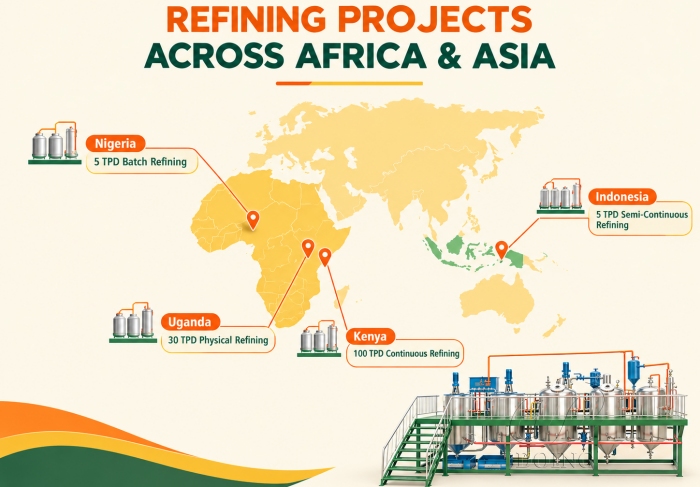 Glory Oiltech edible oil refining project distribution
FAQ
Should I stop alkali refining completely if my soapstock carries too much oil?
No. First confirm whether the cause is dosing or separation. If NaOH is over-dosed, correcting the calculation based on real FFA solves it at almost no cost. If dosing is correct and soapstock still carries oil, the problem is separation, and moving from gravity settling to centrifugal separation is the practical step. Stopping alkali refining without checking crude quality usually creates new problems such as off-flavors and color reversion.
Why does my oil lose quality after refining even though yield looks acceptable?
Yield and quality are not the same indicator. If phospholipids were not fully removed, the oil can darken again after storage, and if deodorization ran with weak vacuum or low temperature, odors can return later. A mill can look efficient on paper while producing oil that customers reject. Check degumming completeness and deodorization stability before blaming the crude.
What information should I prepare before asking a supplier for a refining solution?
Prepare a crude oil test report covering free fatty acids, moisture and impurities, phospholipid content and color, plus your target product grade, daily capacity, available utilities such as steam and power, and local wastewater limits. With these details a supplier can tell whether chemical refining, physical refining or a combined route fits, instead of selling a generic edible oil refining equipment line.
Is an expensive refining line always better for reducing loss?
Not necessarily. A costly fully continuous line running below its design capacity often wastes more than a well-matched smaller line. Loss control depends on whether the configuration fits your crude profile and operating hours. Ask any supplier to explain which stage of their design reduces your specific loss, and be careful with anyone who promises a fixed yield improvement without seeing your crude data or your edible oil refining plant layout.
Get Your Customized Refining Line Proposal
High oil loss during edible oil refining is traceable once you follow the oil through degumming, neutralization, bleaching and deodorization, and Glory Oiltech can help you map those leak points against your crude quality, capacity and local utility conditions. Send over your crude oil test report, current refining route and daily output, and we will review the process and prepare a customized configuration and cost proposal. Contact us today for a free consultation.
 PREV:Oilseed pretreatment guide: Choosing the right process and equipment for each seed type
 NEXT:What equipment do you need for a 50 tpd rice bran oil extraction and refining plant?
Leave a message
If you wanna to get more details about Why is oil loss too high during edible oil refining? Causes & solutions, you can send E-mail to sales@doingoilmachine.com. Or you can consult our professional engineers and specialized sales team by leaving a message in below form. We will contact you ASAP. You also can visit our factory in Henan, China.
- QWhat is your raw material?
- QHow many tons do you want to process per day?
- QWhat machine do you want? or other requirement?

