
- 100TPD soybean oil processing plant: expanding pressing vs expanding extraction
- What refining equipment for a small rural oil mill? Complete buyer's guide
- Oilseed pretreatment guide: Choosing the right process and equipment for each seed type
- Why is oil loss too high during edible oil refining? Causes & solutions
- What equipment do you need for a 50 tpd rice bran oil extraction and refining plant?
- Mobile/WhatsApp:
+86 13526627860
- Phone:
+86 13526627860
- Email:
sales@doingoilmachine.com
- Glory Oiltech wins order for 1TPH double screw palm oil press machines for Congo palm project
- Glory Oiltech secures 3 TPH palm kernel oil processing plant order in Nigeria
- Glory Oiltech secures 30 TPD soybean oil processing plant order in Nigeria
- Glory Oiltech (a subsidiary of Doing Holdings) Chairman Zheng Yongye reappointed Vice Chairman of NCCEA
- PALMEX Medan 2026: Meet Glory Oiltech and explore 5 TPH palm oil extraction machine solutions
Blog
Oilseed pretreatment guide: Choosing the right process and equipment for each seed type
Every oilseed carries its own chemical makeup and physical structure, and those differences dictate exactly how it must be prepared before oil can be efficiently extracted. Choosing the wrong pretreatment process not only wastes energy and equipment lifespan but can also drop your oil yield by several percentage points — a costly mistake at commercial scale.
This guide breaks down the core pretreatment steps, compares process configurations for five major oilseeds — rice bran, soybean, rapeseed, sunflower, and sesame, so you can match the right oilseed pretreatment line to your raw material and capacity. Glory Oiltech (Henan Glory) has engineered pretreatment solutions across this full spectrum, and the insights below draw from both our project experience and industry best practices.
Why Pretreatment Decides Your Oil Yield and Refining Cost
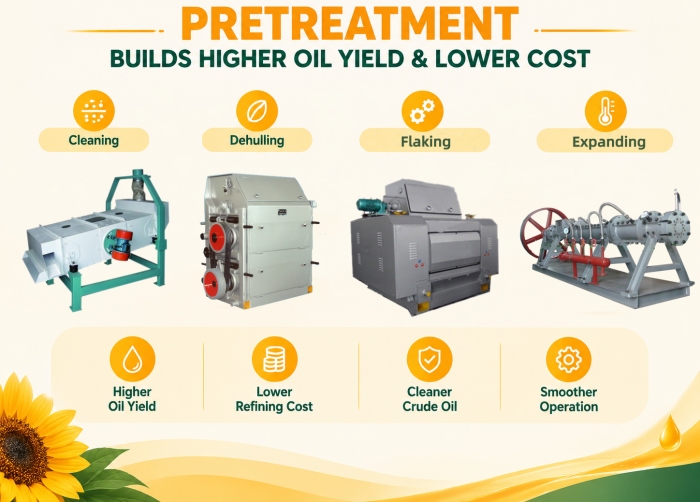
Pretreatment is the foundation that determines how much oil you actually recover and how much downstream refining your crude oil will require. Proper cleaning removes stones, metals, and organic impurities that would otherwise absorb oil, accelerate equipment wear, or contaminate the final product. Dehulling eliminates fibrous husks that lower oil recovery and introduce unwanted wax and color bodies into the crude oil. Cracking and flaking rupture seed cell walls to create maximum surface area, depending on the seed type — so that solvent or press can access oil efficiently. Cooking or extrusion adjusts moisture and temperature to optimize oil fluidity and protein coagulation.
 Oilseed pretreatment equipment
The Core Pretreatment Steps and What Each One Solves
Cleaning and Impurity Removal
The first step removes soil, stems, leaves, stones, and metal contaminants from raw oilseeds using vibrating sieves, air aspirators, and magnetic separators. Skipping this step risks damaging downstream equipment and reducing oil quality, as impurities absorb oil that would otherwise be recovered.
Dehulling
For oilseeds with fibrous husks — sunflower seeds, peanuts, and cottonseeds — dehulling removes the outer shell before pressing. Hulls reduce total oil yield by retaining oil, introduce wax and color compounds into the crude oil, and accelerate wear on pressing screws.
Cracking
Crushing reduces seed size to ensure uniform processing in subsequent steps. Seeds that are too large obstruct oil flow paths, while seeds that are too small increase resistance to oil flow and can block the oil path.
Flaking
Flaking mills pass cracked seeds through rollers to produce thin flakes that rupture cellular structures and maximize surface area for solvent contact.
Cooking and Extrusion
Heat and steam in cookers or screw expanders lower oil viscosity, coagulate proteins, and prepare material for efficient oil release.
Glory Oiltech's pretreatment equipment and lines ensure consistent feed quality to downstream processes, helping operators maximize oil recovery and minimize production downtime.
Pretreatment by Seed Type: Which Process Fits Your Raw Material?
Below is a breakdown of the five most commonly processed oilseeds, their characteristic pretreatment flows, and why each step matters for oil recovery.
Rice Bran
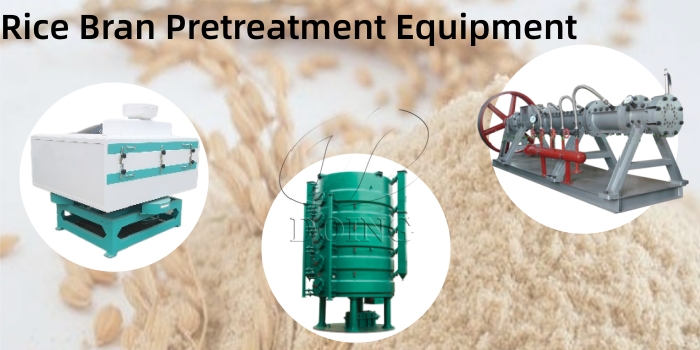
Rice bran → Cleaning (bran separation screen) → Conditioning → Expanding → Drying (plate dryer).
Rice bran is unstable from the moment it leaves the rice mill. It contains active lipases and high moisture, so free fatty acids rise quickly — untreated bran can turn rancid within about six hours. That is why stabilization is the single most important step. Cooking or expanding at 110–130°C deactivates the enzymes and prevents rapid acidification, which protects both oil quality and refining cost. The expanding step also granulates the bran, improving flowability and porosity for easier solvent penetration. After extrusion and drying, stabilized bran can be stored for roughly 10 to 15 days under ideal conditions. Glory Oiltech designs rice bran pretreatment lines that integrate rapid stabilization with controlled drying to preserve oil quality from mill to extractor.
 Rice bran pretreatment equipment
Soybeans
Soybeans → Cleaning (vibrating screen, magnetic separator, destoner) → Cracking → Flaking → Cooking → Extrusion.
Soybeans hold oil inside a dense cellular structure and drain very poorly under pressure alone, so simple pressing leaves a lot of oil behind. Cooking at around 65°C with steam-adjusted moisture improves plasticity and reduces flaking dust. Flaking then ruptures cell walls to create maximum surface area, and cooking further lowers oil viscosity while coagulating proteins. Extrusion is the final and most impactful step: it completely ruptures remaining cells and creates a porous structure that allows solvent to penetrate rapidly and thoroughly. These are the key considerations when specifying soybean pretreatment equipment for your operation.
Rapeseed (Canola)
Rapeseed → Cleaning (vibrating screen, magnetic separator, destoner) → Conditioning → Flaking → Cooking.
Rapeseed is high in oil and contains glucosinolates together with the enzyme that acts on them when moisture and heat are present. Conditioning and cooking are therefore critical: proper heat inactivates the enzyme, limits unwanted compounds, and coagulates protein so the seed releases oil more easily.
Sunflower Seeds
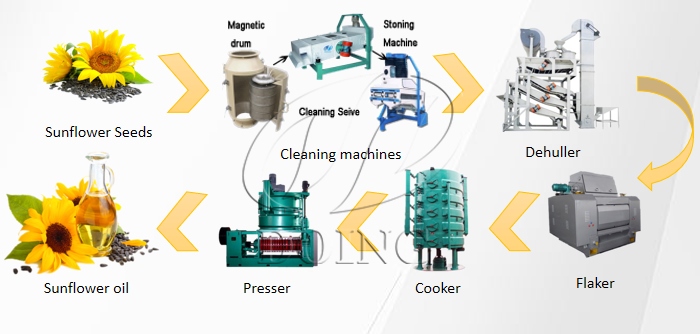
Sunflower seeds → Cleaning (vibrating screen, magnetic separator, destoner) → Dehulling → Shell Separation → (Flaking) → Cooking.
Sunflower hulls are fibrous, almost oil-free, highly abrasive and absorb a noticeable amount of oil. If they stay in the material, you lose oil in the cake, wear out press screws and flake rolls faster, and end up with a meal low in protein. Dehulling and shell separation are the critical steps in sunflower seed pretreatment that decide both oil recovery and meal value, while flaking before pressing increases surface area and improves drainage.
 Sunflower seed pretreatment equipment
Sesame
Sesame → Cleaning (magnetic separator, vibrating screen, destoner) → Cleaning (vibrating screen, destoner, vibrating screen) → Roasting (roaster).
Sesame is small, oil-rich and valued for its aroma, so cleaning and roasting control the result. Because sesame seeds are so small, impurities such as stone dust, sand, and plant debris are difficult to separate by size alone — that is why sesame pretreatment requires two consecutive cleaning stages. Roasting is where sesame becomes sesame oil. Unlike other oilseeds that use steam cooking, sesame traditionally requires direct-fire or high-temperature roasting (ideally 180–200°C) to develop the characteristic aroma compounds through Maillard reactions. For aromatic sesame oil, many mills press at carefully controlled roasting temperatures to preserve the signature flavor.
How to Choose the Right Pretreatment Line for Your Operation
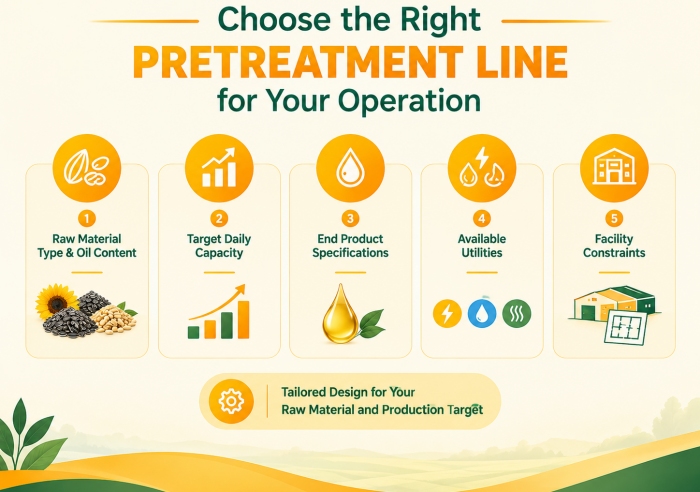
Selecting the appropriate pretreatment equipment comes down to five key factors:
1. Raw material type and oil content — Determines which steps are essential (e.g., dehulling for sunflower, enzyme deactivation for rice bran).
2. Target daily capacity — the equipment and production line configurations required for small plants (1–10 tons/day) and large plants (50 tons/day and above) also differ.
3. End product specifications — Food-grade oil for human consumption demands stricter impurity removal and temperature control than industrial oil.
4. Available utilities — Steam, electricity, and water availability influence whether you choose steam-assisted conditioning or dry processing.
5. Facility constraints — Available floor space, ceiling height, and layout affect equipment configuration and line layout.
Glory Oiltech's engineering team provides a detailed site preparation checklist during the design phase, ensuring that your pretreatment line is sized and configured for your specific raw material and production target.
 Factors in selecting oilseed pretreatment equipment
FAQ
What steam and power requirements should I plan for a pretreatment workshop?
Steam consumption depends primarily on the cooking/extrusion step and the scale of operation. A general rule is that steam requirements scale with the capacity of your cooker or expander. Power demand is driven by cleaning equipment, crushers, flakers, and conveyors. Glory Oiltech's engineering team can provide a detailed utility calculation based on your chosen equipment configuration and daily capacity during the design phase.
How do I know if my current pretreatment is underperforming?
Watch for these warning signs: oil yield dropping below expected benchmarks for your seed type, high residual oil in the cake (above 8% for pressing), excessive fine particles in the crude oil, or inconsistent oil color and flavor batch to batch. Conducting a pretreatment audit — reviewing moisture controls, flake thickness consistency, cooking temperature logs, and equipment wear patterns — usually pinpoints the root cause within one week.
Is expanding always necessary, or can I skip it to reduce capital cost?
Expanding is not mandatory for all oilseeds, but it significantly improves extraction efficiency for most. For rice bran, expanding granulation is essential to create a free-flowing feed that prevents channeling in the extraction vessel. For soybeans, expanding after flaking further ruptures cells and gelatinizes proteins, boosting oil yield by several percentage points compared to flaking alone. If capital is constrained, start with flaking plus cooking — you can add expanding later as a capacity and yield upgrade.
Ready to Optimize Your Oilseed Pretreatment Process?
Whether you are processing rice bran, soybeans, sunflower seeds, or any other oilseed, getting the pretreatment right from day one saves money, boosts yield, and protects equipment investment. Glory Oiltech provides customized oilseed pretreatment solutions — from cleaning and dehulling through flaking, cooking, and extrusion — engineered to your specific raw material, capacity, and budget. Contact us today to discuss your project and receive a tailored pretreatment line proposal.
 PREV:What refining equipment for a small rural oil mill? Complete buyer's guide
 NEXT:Why is oil loss too high during edible oil refining? Causes & solutions
Leave a message
If you wanna to get more details about Oilseed pretreatment guide: Choosing the right process and equipment for each seed type, you can send E-mail to sales@doingoilmachine.com. Or you can consult our professional engineers and specialized sales team by leaving a message in below form. We will contact you ASAP. You also can visit our factory in Henan, China.
- QWhat is your raw material?
- QHow many tons do you want to process per day?
- QWhat machine do you want? or other requirement?

