
- 100TPD soybean oil processing plant: expanding pressing vs expanding extraction
- What refining equipment for a small rural oil mill? Complete buyer's guide
- Oilseed pretreatment guide: Choosing the right process and equipment for each seed type
- Why is oil loss too high during edible oil refining? Causes & solutions
- What equipment do you need for a 50 tpd rice bran oil extraction and refining plant?
- Mobile/WhatsApp:
+86 13526627860
- Phone:
+86 13526627860
- Email:
sales@doingoilmachine.com
- Glory Oiltech wins order for 1TPH double screw palm oil press machines for Congo palm project
- Glory Oiltech secures 3 TPH palm kernel oil processing plant order in Nigeria
- Glory Oiltech secures 30 TPD soybean oil processing plant order in Nigeria
- Glory Oiltech (a subsidiary of Doing Holdings) Chairman Zheng Yongye reappointed Vice Chairman of NCCEA
- PALMEX Medan 2026: Meet Glory Oiltech and explore 5 TPH palm oil extraction machine solutions
What refining equipment for a small rural oil mill? Complete buyer's guide
If you run a small rural oil mill and want to turn crude oil into saleable edible oil, a batch-type refining setup is usually the best place to start. It's flexible, doesn't require a huge upfront investment, and can handle different oilseeds as your supply changes.
Glory Oiltech (Henan Glory) makes edible oil refining equipment in the 0.5–20 TPD range that works well for mills like yours — though the exact configuration will depend on your specific oil type, daily capacity, and what quality you need in the finished product.
Why Crude Oils Need Refining
Crude oil straight from the press often contains gums, free fatty acids, pigments, moisture, and other impurities. These affect the oil's appearance, stability, and suitability for sale as edible oil. Refining removes or reduces these unwanted components, helping oil mill owners produce oil that meets their target market's quality requirements.
Palm Oil: Crude palm oil naturally contains carotenoids, which give it its characteristic deep red-orange color. Its free fatty acid (FFA) content can also increase significantly when palm fruits are damaged or stored too long before processing.
Cottonseed Oil: Cottonseed oil presents a different challenge: it contains gossypol, a naturally occurring compound that must be controlled to meet edible oil safety requirements. Crude cottonseed oil can also have a deep color, along with gums and free fatty acids.
Rapeseed Oil: Crude rapeseed oil can have a strong, pungent smell due to its natural volatile compounds and processing conditions. Even when its appearance is acceptable, the odor may be undesirable for consumers who prefer a mild-flavored cooking oil.
Sunflower Oil: Crude sunflower oil can contain phospholipids, free fatty acids, pigments, and suspended impurities. These can contribute to processing difficulties, unwanted color, cloudiness, or sediment in the finished oil.
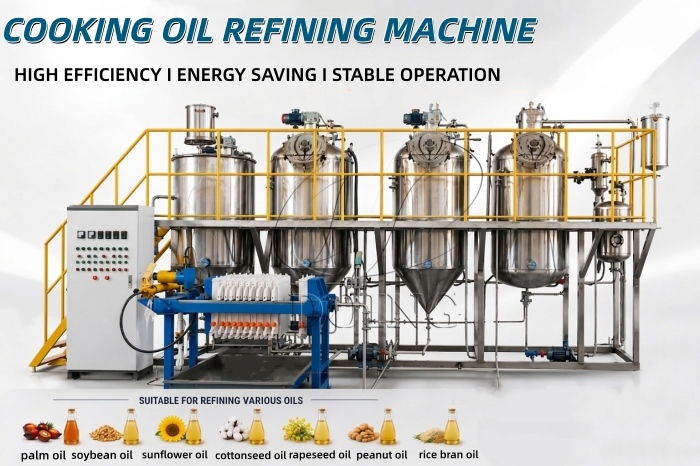 Batch type edible oil refinery machine
What a Small Oil Refining Line Does and What It Includes
A working refining line is just a set of equipment that does specific jobs in sequence. Here's what each step actually does and what hardware you'd need:
Degumming pulls out phospholipids, proteins, and other gummy stuff from the crude oil. You do this in a refining tank — you heat the oil, add water or acid, and the gums hydrate and separate out.
Neutralization (or deacidification) lowers the free fatty acid content, which makes the oil more stable and gives it a longer shelf life. This also happens in the refining tank, using an alkali solution that turns free fatty acids into soapstock, which then gets separated out.
Bleaching fixes the color. You mix the oil with bleaching earth or activated carbon, heat it up, then filter out the spent earth along with whatever pigments and impurities it grabbed. You need a bleaching tank plus filtration equipment for this.
Deodorization gets rid of bad smells and flavors, plus any remaining free fatty acids and volatile compounds. This one needs a deodorizer tank, a good vacuum system, and a high-temperature heating setup to strip those volatiles under vacuum.
The point is: these pieces of small oil refinery equipment need to work together. You can't just buy a tank and expect it to work — you need the heating, the vacuum, the filtration, all matched to your process.
 Small edible oil refining equipment
Which Batch Refining Capacity Is Right for Your Oil Mill
Glory Oiltech supplies batch refining equipment for operations from 0.5 to 20 TPD. That covers most small rural oil mills. Here's what you need to know when picking the right size and setup:
Batch refining works best when you're processing 20 TPD or less. It's simple to operate, costs less upfront, and lets you switch between oil types easily — which matters a lot if your raw material supply changes with the seasons.
A typical batch line includes a refining tank (sometimes called a neutralization tank), a bleaching tank, a deodorizer, a filter, a vacuum pump, and a heat transfer oil furnace. You can tweak the exact equipment list based on your budget and the quality you need.
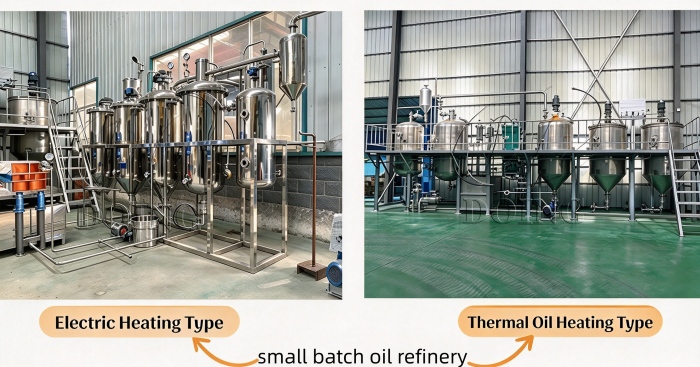 Two types of small batch oil refinery
There are two heating options:
Electric heating (0.5–2 TPD): Uses resistance heaters to warm the oil. Cheaper to buy, but it eats electricity and needs stable voltage — so it works if you have reliable power and tight budgets, but your running costs will be higher.
Thermal oil heating (≥1 TPD): Uses a heat transfer oil furnace for steady, indirect heating. Costs more upfront because you need the furnace, but it's more energy-efficient and cheaper to run over time. That usually makes more sense for a rural mill that plans to keep going.
When you're figuring out what size you need, start with how much crude oil you process each day, how many batches you can run, what oil types you handle, and what quality the finished oil needs to be. Keep in mind: the equipment's rated capacity isn't the same as how much finished oil you'll get out — actual yield depends on your oil recovery rate and the specific conditions of your mill.
FAQ
Can I just filter my crude oil instead of refining it?
Filtering will clear up some sediment and make the oil look better, but it won't touch free fatty acids, gums, pigments, or bad smells. If you're selling oil commercially, you usually need more than just filtration. Whether you need a full refining line depends on your oil's condition and what quality you're trying to achieve.
Is a batch refining line enough for a rural oil mill?
For a lot of small rural operations, yes. Batch equipment handles variable output, different oil types, and tight budgets pretty well. But if you process the same oil every day at steady volume and want continuous operation, you might want to look at semi-continuous options. Most rural mills find the flexibility of batch processing more useful than the efficiency of a continuous line.
How do I know if my crude oil needs deodorizing?
Look at your finished oil. Does it smell bad? Do your customers care about the smell? Do you need it to last longer on the shelf? If yes to any of those, deodorization is probably worth it. Some rural markets actually like the natural smell of un-deodorized oil, so this is as much a market decision as a technical one.
Can I start small and expand later?
Absolutely. Many small rural oil mills start with a modest batch setup and grow from there. Just think ahead about your site layout, electrical capacity, heat source, and storage when you plan. That way, when you do expand your small scale edible oil refining operation later, you won't have to tear everything out and start over.
Get the Right Refining Solution from Glory Oiltech
Every rural oil mill is different. The crude oil you get, how much you process, what quality you need, and what you've got on site — they all shape what kind of edible oil refining plant makes sense for you. That's how Glory Oiltech works. We look at your actual conditions and figure out what refining equipment for small oil mill operations will actually work for your situation.
To get started, tell us:
What oilseeds are you processing?
How many tons per day do you need to handle?
What quality standards does your finished oil need to meet?
What utilities and space do you have available?
Contact Glory Oiltech to discuss a batch refining solution for your small oil mill. We'll help you figure out what you actually need before we talk about equipment.
 PREV:100TPD soybean oil processing plant: expanding pressing vs expanding extraction
 NEXT:Oilseed pretreatment guide: Choosing the right process and equipment for each seed type
Leave a message
If you wanna to get more details about What refining equipment for a small rural oil mill? Complete buyer's guide, you can send E-mail to sales@doingoilmachine.com. Or you can consult our professional engineers and specialized sales team by leaving a message in below form. We will contact you ASAP. You also can visit our factory in Henan, China.
- QWhat is your raw material?
- QHow many tons do you want to process per day?
- QWhat machine do you want? or other requirement?

