
- What is a corn germ oil processing line and how does it work?
- Which supplier can provide a turnkey peanut oil processing plant in Africa?
- Sunflower oil processing plant: capacity, process, equipment and project planning guide
- Soybean puffing and pressing process: Complete equipment & flow guide
- How to process CPO into edible cooking oil: complete crude palm oil refining process
- Mobile/WhatsApp:
+86 13526627860
- Phone:
+86 13526627860
- Email:
sales@doingoilmachine.com
- Want to process peanuts into oil? Here's how one Nigerian customer did it — 3TPD peanut oil expeller
- Henan Glory secures order from Azerbaijan for 35TPD vertical steam cooker
- Henan Glory to showcase 1tph integrated palm oil pressing Line at PALMEX Thailand 2026
- Palm kernel oil extraction machine: Local pickup completed at Henan Glory Nigeria warehouse
- Nigerian customer collects 500kg/h diesel palm oil mill plant from Henan Glory Nigeria warehouse
What is a corn germ oil processing line and how does it work?
A corn germ oil processing line is an integrated system that converts separated corn germ into crude corn germ oil and, when required, refined corn germ oil. The typical process includes cleaning, softening, flaking, cooking, oil extraction and refining.
In this article, Glory Oiltech (Henan Glory) walks you through the complete working flow of corn germ oil processing.
Raw Material: Corn Germ
Corn germ is the embryo portion of the corn kernel and is the main oil-bearing fraction of the kernel. While a whole corn kernel contains only 3–5% oil, the germ itself can range from 15% to 50% oil depending on whether it is recovered from dry milling (15–25% oil) or wet milling (40–50% oil). This makes corn germ — obtained as a by-product of starch processing, ethanol production, and corn milling — a practical and commercially significant feedstock for oil production.
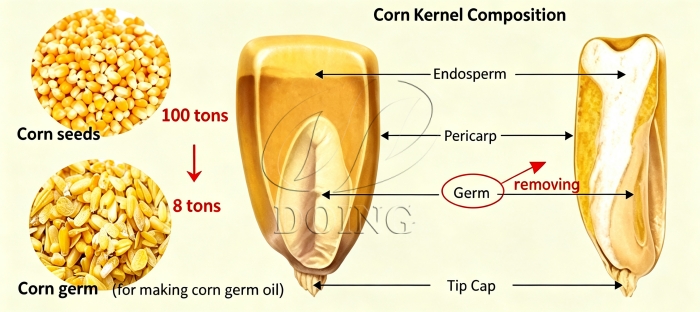 Corn germ
How Does a Corn Germ Oil Processing Line Work?
The overall process can be summarized as:
Corn Germ → Cleaning → Softening → Flaking → Cooking → Oil Extraction → Crude Corn Germ Oil → Refining → Refined Corn Germ Oil
Step 1. Corn Germ Cleaning
The first stage is cleaning, which normally includes vibrating screening and magnetic separation.
Vibrating Screening
Vibrating screening removes coarse foreign materials and unwanted particles from the incoming corn germ. Depending on the source of the germ, the raw material may contain fines, bran or other non-germ particles in addition to ordinary foreign materials.
Removing these materials before conditioning and pressing helps maintain a more uniform feed and reduces the risk of unwanted material entering downstream processing equipment.
Magnetic Separation
Magnetic separation removes ferrous metal particles that may be present in the raw material.
This is particularly important before equipment such as the flaker and oil press, where metal contamination can cause mechanical damage. Cleaning is therefore not simply a quality-control step; it also prepares the material for stable mechanical processing.
After cleaning, the corn germ moves to the softening stage.
Step 2. Corn Germ Softening
Softening adjusts the physical condition of the cleaned corn germ, particularly its moisture and temperature, before flaking. The germ is typically conditioned to around 60–70°C, with its moisture adjusted to approximately 10–12% before flaking.
The objective is to make the germ sufficiently plastic for mechanical processing while creating a condition that supports effective oil release later in the process.
Step 3. Flaking the Corn Germ
After softening, the corn germ passes through a flaking operation.
The germ is compressed into thin flakes so that its cellular structure is disrupted and the oil becomes more accessible during subsequent cooking and pressing.
At the same time, the flakes need to retain enough structure for the press to develop effective compression. Excessive structural breakdown can produce too many fines and make mechanical oil separation more difficult.
Step 4. Cooking the Flaked Corn Germ
Cooking changes the moisture and thermal condition of the flakes and promotes the release and aggregation of oil within the material. It also changes the physical properties of proteins and other components, helping create a more suitable structure for mechanical pressing.
The flaked corn germ is generally cooked at approximately 105–120°C for 40–50 minutes, depending on the condition of the corn germ and the desired pressing performance.
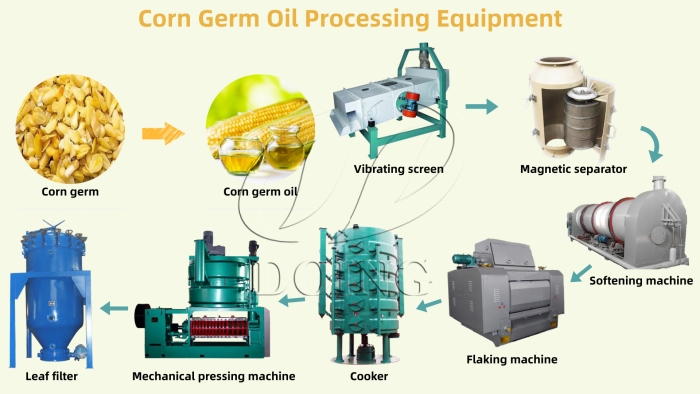 Corn germ oil mechanical pressing process
Step 5. Corn Germ Oil Extraction
There are two extraction methods for corn germ oil: mechanical pressing and pre-pressing + solvent extraction.
The mechanical pressing route can be represented as:
Corn Germ → Cleaning → Softening → Flaking → Cooking → Pressing → Crude Corn Germ Oil + Press Cake
Inside a screw press, the prepared material is conveyed forward while being progressively compressed. Oil is forced out of the material and collected as crude corn germ oil, while the remaining solid material leaves the press as press cake.
Mechanical pressing does not normally remove all of the oil contained in the germ. The remaining oil in press cake can therefore represent a meaningful portion of the raw material’s recoverable oil.
For higher oil recovery, the process can continue as:
Press Cake → Solvent Extraction → Crude Corn Germ Oil + Defatted Meal
This processing route is especially well suited for corn germ, as corn germ features a high inherent oil content. Combined pre-pressing and solvent extraction can achieve an overall oil recovery of roughly 90%–99%, although the actual recovery varies with feedstock characteristics and processing conditions.
Instead of treating the remaining oil in the press cake as an unavoidable loss, solvent extraction provides a second recovery stage.
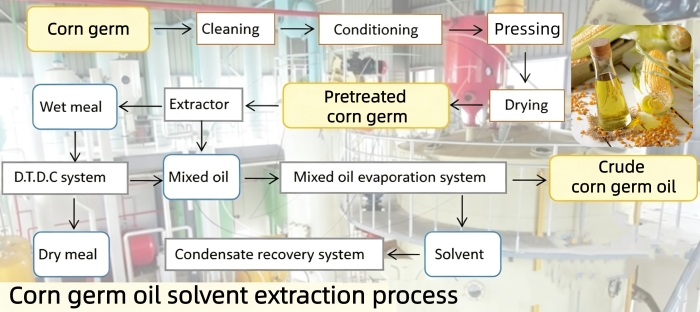 Corn germ oil solvent extraction process
The two methods therefore have different roles:
(1)Mechanical pressing: removes oil by mechanical compression.
(2)Solvent extraction: recovers additional oil remaining in the press cake.
The resulting oil streams are crude oil and can then enter the refining section.
How Is the Extracted Crude Corn Germ Oil Refined?
The extraction stage produces crude corn germ oil, but the oil still contains phospholipids, free fatty acids, pigments, waxes and other minor impurities. Refining removes or reduces these unwanted components step by step so that the oil can meet the required edible-oil quality specification.
Typical refining operations include:
Degumming → Deacidification → Bleaching → Dewaxing When Required → Deodorization
Degumming
Degumming removes phospholipids, gums and other colloidal impurities from crude corn germ oil.
Phospholipids can make crude oil dark, cloudy or difficult to process in later refining stages. During degumming, water and/or an acid treatment is used to hydrate or condition these phospholipids so they can be separated from the oil.
Deacidification
Deacidification reduces free fatty acids (FFA) in the crude oil.
In chemical refining, an alkali such as caustic soda reacts with FFA to form soap, which is then separated from the oil. This reduces the oil's acidity and removes the FFA that would otherwise remain in the finished product.
Bleaching
Bleaching removes pigments and other adsorbable impurities from the oil.
The oil is treated with adsorbent materials, typically bleaching earth, which captures color pigments and other adsorbable substances. These materials are then separated from the oil by filtration.
Dewaxing When Required
Corn germ oil can contain waxes that crystallize as the oil temperature falls, causing haze or cloudiness.
If the finished oil needs to remain clear at lower temperatures, dewaxing or winterization can be added to crystallize and separate these waxes.
Dewaxing is not necessarily required for every corn germ oil project. It is mainly determined by the wax content of the crude oil and the clarity requirement of the finished product.
Deodorization
Deodorization removes volatile compounds that give the oil an undesirable odor or flavor.
The oil is treated under high temperature and vacuum so that volatile odor and flavor compounds can be stripped from the oil.
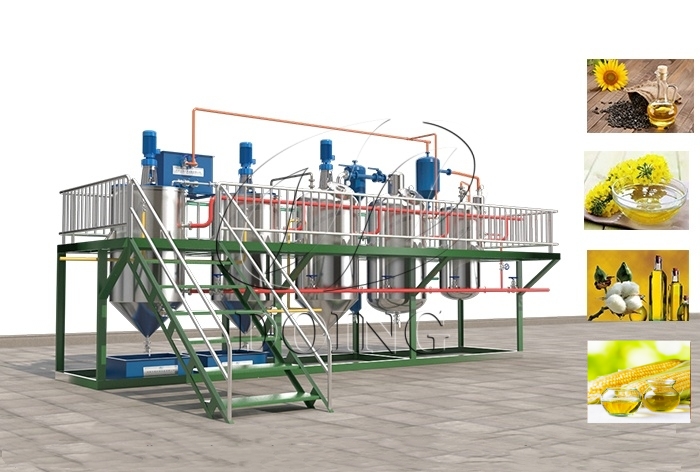 Corn germ oil refining process
After the required refining stages are completed, the product becomes refined corn germ oil.
Frequently Asked Questions About Corn Germ Oil Processing
How do I choose between mechanical pressing and pre-pressing plus solvent extraction for a new corn germ oil plant?
The choice depends primarily on three factors: processing scale, target oil recovery, and available investment. Mechanical pressing suits small-to-medium operations where simpler equipment, lower capital cost, and solvent-free operation are priorities. Pre-pressing plus solvent extraction is preferred for medium-to-large scale projects where maximizing oil recovery (90–99%) justifies the higher equipment cost and operational complexity.
What should be checked before processing a batch of corn germ?
Before processing, check the following key characteristics of the corn germ:
(1)Oil content — indicates the oil available for recovery.
(2)Moisture — affects conditioning, flaking and pressing behavior.
(3)Impurities — including stones, metal and non-germ particles.
(4)Starch or bran contamination — affects raw-material purity.
What are the commercial uses of corn germ meal after oil extraction?
Corn germ meal is the defatted residue after oil extraction, containing 20–25% protein along with starch and fiber. It is mainly used as a protein supplement for poultry, cattle and swine feed, and also works well in aquafeed due to its balanced protein and digestible carbs. This byproduct can contribute meaningfully to overall plant revenue. Press cake from single pressing retains 5–8% residual oil and fetches higher prices in certain feed markets, while solvent-extracted defatted meal has lower oil content but higher protein proportion.
What are common operational problems in corn germ oil plants and their likely causes?
(1)Low press oil yield: usually traced to inadequate cooking (wrong moisture/temperature), poor flake quality, or low germ oil content — not the press itself.
(2)High refining loss: often caused by high FFA or excessive phospholipids in crude oil, indicating upstream germ quality or extraction issues.
(3)Emulsion during degumming: typically from incorrect water dosing or oil temperature outside the 60–85°C range.
(4)Cloudy finished oil: residual wax not removed; check dewaxing temperature and filtration.
(5)Off-flavor recurrence after deodorization: usually insufficient vacuum, low stripping temperature, or degraded steam quality.
Does every corn germ oil plant need dewaxing?
No. Dewaxing is mainly considered when the crude corn germ oil contains enough wax to cause haze at lower temperatures or when the finished oil must maintain a high level of clarity. If the finished-oil specification does not require this performance, dewaxing may not be included in the refining process.
Planning a Corn Germ Oil Processing Project?
Have a supply of separated corn germ and plan to produce corn germ oil?
Send us your corn germ source, oil content, moisture, available raw-material quantity and target processing capacity.
If you are unsure which extraction route is suitable, our technical team at Glory Oiltech can evaluate the process based on your actual raw material and production requirements.


Leave a message
If you wanna to get more details about What is a corn germ oil processing line and how does it work?, you can send E-mail to sales@doingoilmachine.com. Or you can consult our professional engineers and specialized sales team by leaving a message in below form. We will contact you ASAP. You also can visit our factory in Henan, China.
- QWhat is your raw material?
- QHow many tons do you want to process per day?
- QWhat machine do you want? or other requirement?

