
- Cold pressing vs hot pressing oil expeller: Yield & quality differences explained
- 5 TPD cottonseed oil pressing line: Complete setup from cleaning to filtering for startups
- Screw press vs hydraulic oil press: Key differences & selection guide for edible oil production
- 100TPD soybean oil processing plant: expanding pressing vs expanding extraction
- What refining equipment for a small rural oil mill? Complete buyer's guide
- Mobile/WhatsApp:
+86 13526627860
- Phone:
+86 13526627860
- Email:
sales@doingoilmachine.com
- The 19th Nigeria (Lagos) China Commodities Expo 2026: Glory Oiltech Presents Complete Palm Oil Processing Solutions at Booth 1B09
- Glory Oiltech to showcase 1 TPH integrated palm oil processing line at PALMEX Malaysia 2026
- Glory Oiltech wins order for 1TPH double screw palm oil press machines for Congo palm project
- Glory Oiltech secures 3 TPH palm kernel oil processing plant order in Nigeria
- Glory Oiltech secures 30 TPD soybean oil processing plant order in Nigeria
Blog
Sunflower oil processing plant: capacity, process, equipment and project planning guide
Setting up a sunflower oil processing plant requires more than selecting an oil press. The right configuration depends on the available sunflower seeds, target processing capacity, required oil recovery, final product quality, utilities and the overall project scope.
Based on its experience in sunflower oil processing projects, Glory Oiltech provides equipment and process solutions for different sunflower oil production capacities and final product requirements. This guide takes you through the plant stage by stage — capacity, extraction process, equipment, refining and dewaxing — so you can define a complete project scope before investing in hardware.
The Sunflower Oil Production Line at a Glance
A sunflower oil processing plant is not a single machine but a connected sequence of stages, from sunflower seed intake to bottled edible oil. Because each stage feeds the next, a well-designed plant is planned as one integrated line before individual machines are selected:
Sunflower seeds → Cleaning → Dehulling & flaking → Conditioning → Oil extraction (mechanical pressing or solvent extraction) → Crude oil filtration & storage → Refining (degumming → deacidification → bleaching → deodorization) → Dewaxing → Filling & packaging
Within this line, three decisions shape the entire project: how much you process per day, how you extract the oil, and what quality of finished oil you sell. Each decision is covered in turn below, together with the equipment that follows from it.
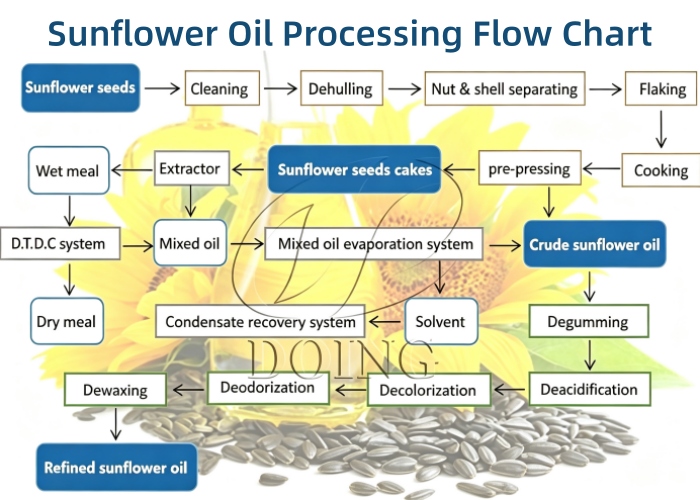 Complete sunflower oil processing process
Capacity: How Big Should Your Sunflower Oil Plant Be?
Capacity is the first decision because it drives equipment size, building layout, utility demand and investment. There is no single capacity that suits every sunflower oil project: in practice, the plant size should be determined by the available sunflower seed supply, expected annual operating volume, investment level and the required degree of automation.
In typical sunflower oil projects, Glory Oiltech provides processing solutions across the following capacity ranges:
| Plant scale | Processing capacity | Process options to consider | Typical application |
| Small-scale | 1–20 TPD | Mechanical pressing | Local oil mills, small businesses and regional markets |
| Medium-scale | 20–50 TPD | Mechanical pressing or solvent extraction | Commercial and regional oil-processing plants |
| Large-scale | >50 TPD | Mechanical pressing or solvent extraction | Industrial and larger commercial oil mills |
Note: These ranges are indicative. A project at a boundary capacity (e.g., 20 or 50 TPD) can be engineered toward either adjacent configuration depending on automation level, seed supply and expansion plans — Glory Oiltech will confirm the most suitable option during process design.
Once capacity is fixed, the next decision is how the oil will be extracted — the process route.
Process: Choosing Between Mechanical Pressing and Solvent Extraction
Neither mechanical pressing nor solvent extraction is universally better. The appropriate choice depends on the required oil recovery, plant capacity, investment level and operating conditions.
Mechanical pressing extracts oil from prepared sunflower seeds using a screw oil press, with no chemical solvents involved. It is often the practical starting point for smaller projects: the process flow is relatively simple, operation and maintenance are easier, no solvent recovery section is required, and the initial investment is lower than for a complete solvent extraction plant.
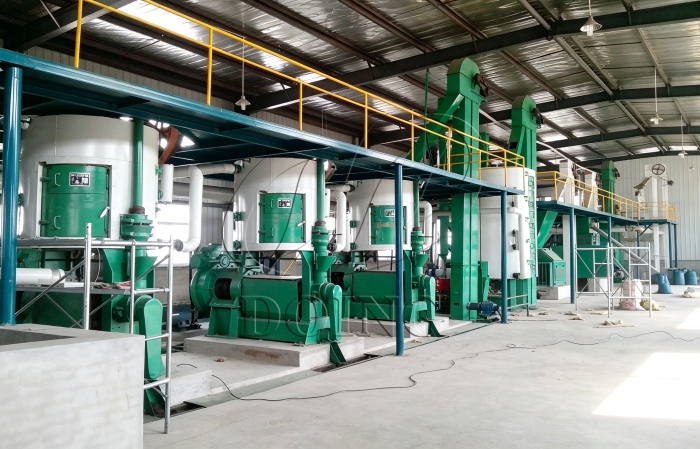 Mechanical sunflower oil press machine
Solvent extraction takes over where pressing stops. Seeds are first pressed mechanically to recover the major portion of the oil; the remaining oil stays in the press cake, which is then sent to the solvent extraction section for further recovery. Under appropriate operating conditions in typical sunflower oil projects, the residual oil content of the extracted meal can be reduced to below 1%. The main advantage is higher overall oil recovery; the trade-off is that the plant requires additional processing equipment, utilities, safety systems and operating controls.
Solvent extraction is therefore more worth considering when:
(1) Oil recovery is a major economic priority
(2) The plant has relatively high annual utilization
(3) The project can support the additional capital and operating requirements
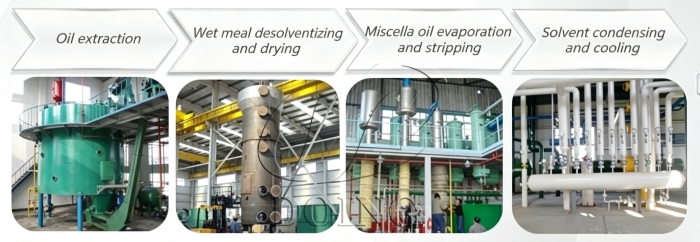 Sunflower seed solvent extraction equipment
Glory Oiltech can provide mechanical pressing and solvent extraction configurations from 1 to 2,000 TPD, with the process selected according to the project's capacity, raw material characteristics, oil recovery requirements and investment conditions.
Mechanical Pressing vs. Solvent Extraction
| Factor | Mechanical pressing | Solvent extraction |
| Initial investment | Lower | Higher |
| Process complexity | Lower | Higher |
| Overall oil recovery | Good | Higher |
| Residual oil in meal | Higher | Can be reduced to<1% |
| Solvent system | Not required | Required |
| Operation | Relatively simple | More complex |
| Safety requirements | Simpler | More demanding |
| Typical capacity range | 1–2,000 TPD | 20–2,000 TPD |
| Main advantage | Simpler process and lower complexity | Higher overall oil recovery |
Note: Exact residual oil values depend on seed quality, moisture and pressing configuration. If your project requires a quantified comparison, Glory Oiltech can provide expected residual-oil targets based on your specific raw material during process design.
Equipment: What Does a Sunflower Oil Processing Plant Need?
The sunflower oil processing equipment configuration follows directly from the selected extraction method, processing capacity and final product requirements. Because seed handling and oil extraction are needed in every plant, most equipment sections are shared across configurations; solvent extraction adds one dedicated section of its own.
| Processing section | Main function | Typical equipment |
| Seed cleaning | Remove foreign materials, stones and metal | Vibrating screen, magnetic separator, destoner |
| Seed preparation | Prepare sunflower seeds for efficient extraction | Dehuller/cracker, shell separator, flaker |
| Conditioning | Adjust moisture and temperature before pressing | Cooker/conditioner |
| Oil extraction | Extract oil from prepared seeds | Screw oil press |
| Solvent extraction | Recover remaining oil from press cake | D.T.D.C. system |
| Crude oil handling | Remove solids and prepare crude oil | Oil filtration and storage equipment |
D.T.D.C. (Desolventizer–Toaster–Dryer–Cooler): the system that removes residual solvent from the extracted meal after solvent extraction, making the meal safe and stable for use as animal feed.
When planning sunflower oil processing equipment, work from the process flow first — the equipment list should be developed from the line as a whole, rather than selecting individual machines independently.
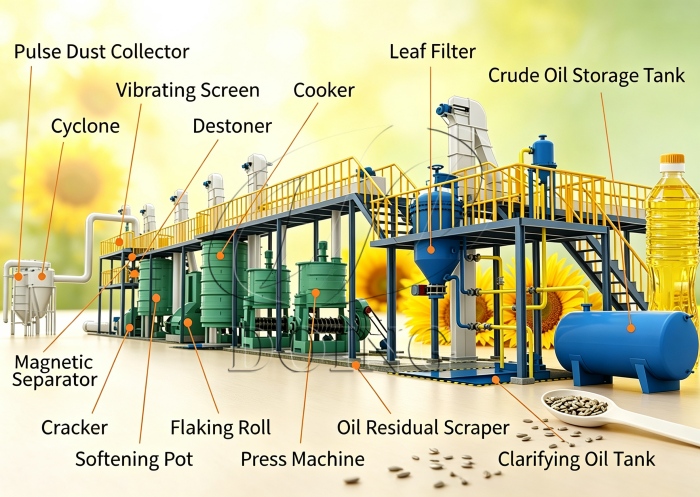 Sunflower oil processing plant equipment
Refining & Dewaxing: How Does Crude Sunflower Oil Become Edible Oil?
Crude sunflower oil obtained from mechanical pressing or solvent extraction normally cannot be sold directly as edible oil. It still contains free fatty acids, phospholipids, pigments, waxes and odor compounds, so the decision on final product quality determines whether refining and dewaxing sections are built into the plant.
The four refining stages
| Refining stage | Main function | Effect on the oil |
| Degumming | Remove phospholipids and gums | Prevents darkening and emulsion problems in later stages |
| Deacidification | Remove free fatty acids | Lowers acidity to edible standard |
| Bleaching | Remove pigments, soap residues and trace impurities | Improves color |
| Deodorization | Remove volatile odor and flavor compounds | Neutral taste and odor |
Together these stages are expressed as: Degumming → Deacidification → Bleaching → Deodorization, and they improve the color, stability, odor and overall quality of the finished oil.
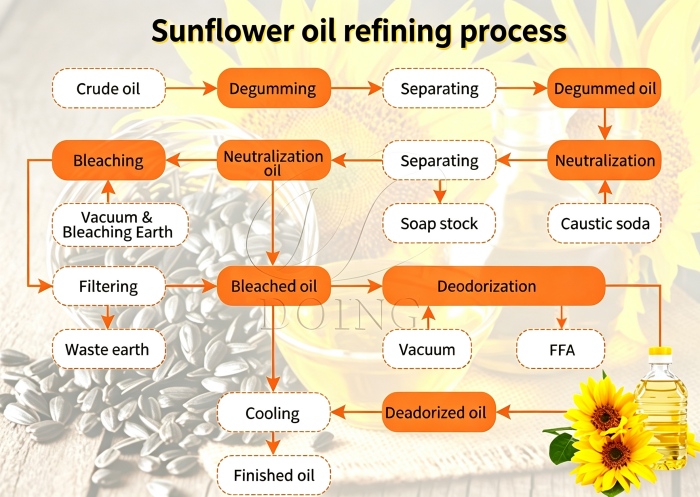 Sunflower oil refining process
Why dewaxing matters for sunflower oil
Sunflower oil contains natural waxes that can cause cloudiness or haze when the oil is stored or used at lower temperatures. Dewaxing uses controlled cooling, crystallization and filtration to separate these waxes and improve the clarity and low-temperature appearance of the finished sunflower oil.
Without dewaxing, bottled sunflower oil can turn cloudy after a short time on a cool shelf — a visual defect that consumers often read as a sign of poor quality. For any project intended to produce clear, packaged edible sunflower oil, dewaxing is therefore an important part of the overall refining configuration.
Sizing the refining and dewaxing section
The refining system should be matched to the required production capacity, final product quality and level of automation.
| Processing system | Typical capacity |
| Batch refining | 0.5–20 TPD |
| Semi-continuous refining | 5–50 TPD |
| Fully continuous refining | ≥30 TPD |
| Dewaxing | 1–600 TPD |
Note: The capacity ranges may overlap (e.g., 5–20 TPD) because the same throughput can be delivered as batch or semi-continuous refining — the choice depends on automation requirements, labor costs and investment budget.
Glory Oiltech provides sunflower oil refining and dewaxing solutions for different processing capacities. After refining and dewaxing, the finished oil can be transferred to storage and then sent to the filling and packaging section according to the final packaging requirements.
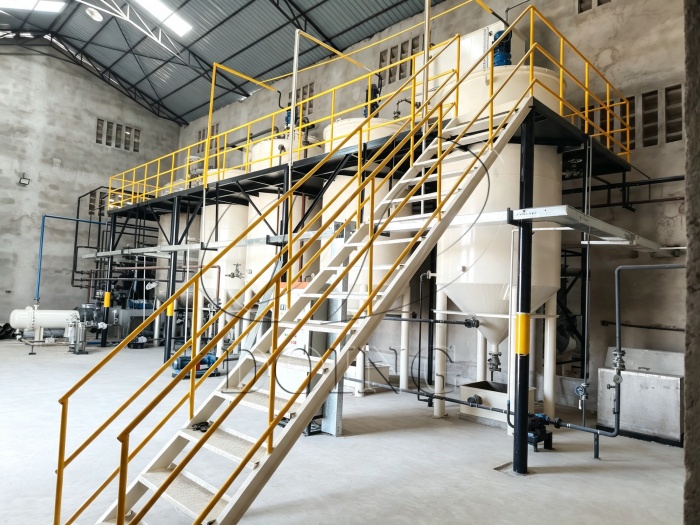 Sunflower oil refinery project site photo
Sunflower Oil Projects by Glory Oiltech
Glory Oiltech has supplied sunflower oil processing and related equipment for projects in different countries and at different production scales. The following reference projects illustrate how the capacity, process and equipment decisions above are applied in practice:
| Country | Capacity | Process | Project Scope |
| Tanzania | 50 TPD | Pressing + solvent extraction | Sunflower oil processing plant |
| Peru | 20 TPD | Refining | Sunflower oil refinery plant |
| Uzbekistan | 5 TPD | Refining + filling | Sunflower oil refining and filling plant |
These projects cover key stages of sunflower oil production, including extraction, refining and finished-oil filling.
Planning a Sunflower Oil Processing Plant?
The right sunflower oil processing configuration depends on your target capacity, sunflower seed characteristics, extraction method, final product requirements and available infrastructure. Share these project basics with Glory Oiltech — our engineering team will evaluate the appropriate process flow and equipment scope and respond with a tailored proposal.
How do I choose between mechanical pressing and solvent extraction for sunflower oil?
Base the choice on four factors: oil recovery priority, capacity, investment and operating conditions. Mechanical pressing offers a simpler flow, easier operation and lower initial investment — practical for 1–20 TPD projects. Solvent extraction recovers more oil (residual oil in meal can drop below 1%) but requires higher capital and stricter safety systems — worth considering when oil recovery is a major economic priority and annual utilization is high.
What capacity should my sunflower oil processing plant be?
Capacity should match your available seed supply and expected annual operating volume. As a reference, Glory Oiltech configures small-scale plants at 1–20 TPD, medium-scale at 20–50 TPD and large-scale above 50 TPD, with refining systems from 0.5 TPD batch units up to 600 TPD dewaxing lines.
Why is dewaxing especially important for sunflower oil?
Sunflower seeds contain a relatively high level of natural waxes from the seed coat. If not removed, the waxes crystallize at low temperature and make bottled oil look cloudy — a defect consumers often reject. Dewaxing keeps packaged sunflower oil clear in cold storage and cool climates, so it is essential for retail-quality products.
What is the difference between crude and refined sunflower oil?
Crude sunflower oil is the direct product of pressing or solvent extraction and still contains free fatty acids, phospholipids, waxes, pigments and odor compounds. Refining removes these impurities, and dewaxing improves low-temperature clarity, producing a shelf-stable oil that meets retail edible oil standards.
Does Glory Oiltech provide complete turnkey sunflower oil plant solutions?
Yes. Glory Oiltech covers process engineering, equipment manufacturing, export logistics, on-site installation guidance, commissioning and local operator training. Reference projects include a 50 TPD pressing and solvent extraction plant in Tanzania, a 20 TPD refinery in Peru and a 5 TPD refining and filling plant in Uzbekistan.
Can the same plant also process other oilseeds besides sunflower?
Largely yes. Seed cleaning, screw pressing and the refining stages can be adjusted to handle different oilseeds, while preparation sections such as the dehuller and flaker are tuned to the specific seed type. Tell Glory Oiltech your full list of crops so the line can be configured for multi-oilseed flexibility from the start.
What is the difference between batch, semi-continuous and continuous refining?
Batch refining processes oil in discrete batches — lower investment and simpler operation, typical for 0.5–20 TPD. Fully continuous refining runs steadily for large capacities of 30 TPD and above with higher automation. Semi-continuous refining sits between the two (5–50 TPD), balancing flexibility and throughput.
 PREV:Which supplier can provide a turnkey peanut oil processing plant in Africa?
 NEXT:Soybean puffing and pressing process: Complete equipment & flow guide
Leave a message
If you wanna to get more details about Sunflower oil processing plant: capacity, process, equipment and project planning guide, you can send E-mail to sales@doingoilmachine.com. Or you can consult our professional engineers and specialized sales team by leaving a message in below form. We will contact you ASAP. You also can visit our factory in Henan, China.
- QWhat is your raw material?
- QHow many tons do you want to process per day?
- QWhat machine do you want? or other requirement?

